PyMoSim
PyMoSim is a mobility simulator written in Python. We plan to release the source code to public in the near future. If you want to access to the code, you need to make a request to c.foh@surrey.ac.uk, we will grant you access to the code on our github at: https://github.com/cfoh/pymosim.
List of Packages and Modules
Note
The release version of this documentation can be found
here: sim.version.Version.
List of Examples
Example 1
This is a simple example to show how a simulation can be created within 50 lines.
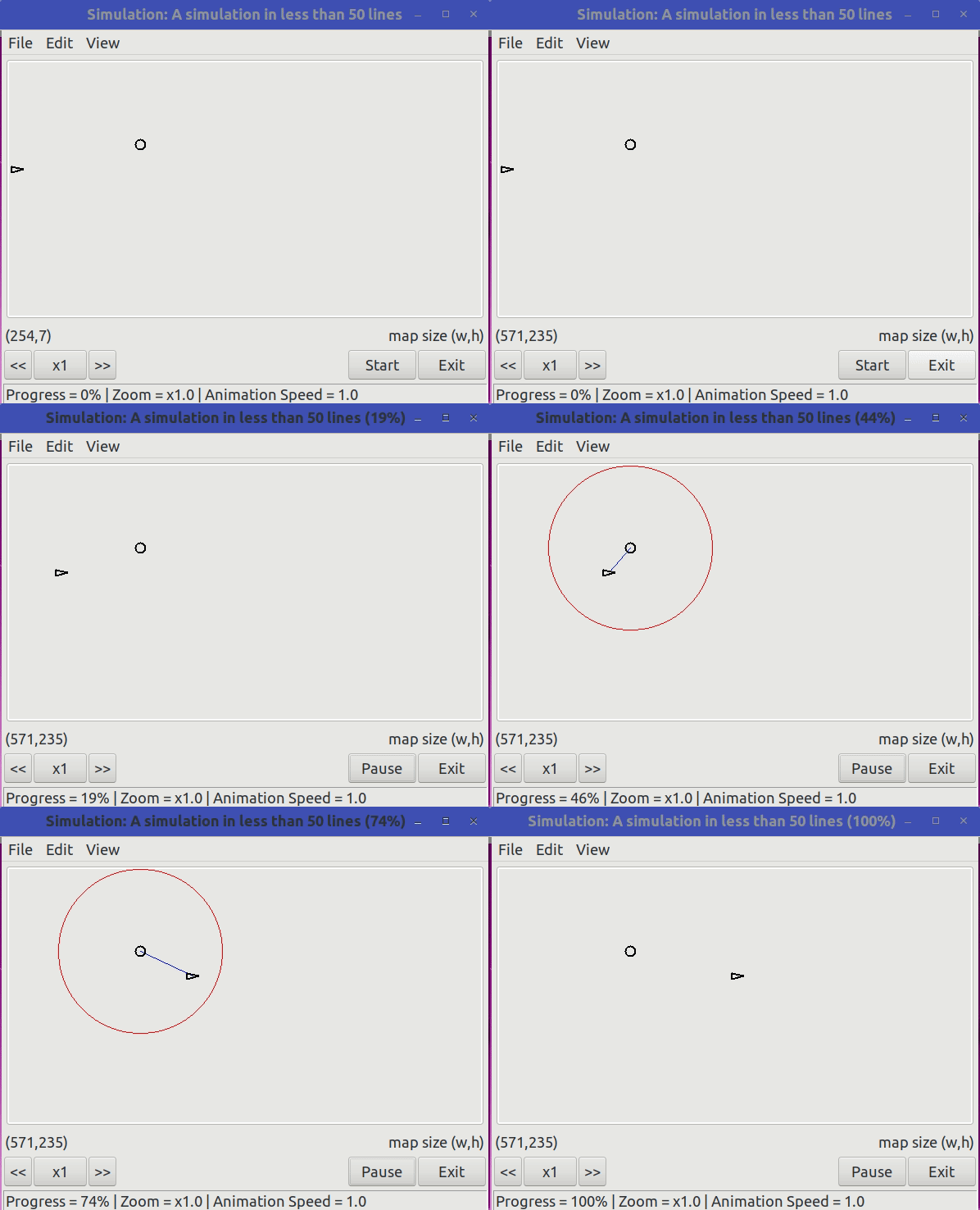
1 2 3 4 5 6 7 8 9 10 11 12 13 14 15 16 17 18 19 20 21 22 23 24 25 26 27 28 29 30 31 32 33 34 35 36 37 38 39 40 41 42 43 44 45 46 47 48 | '''This is a simple example to show how a simulation can be created within 50 lines.'''
from sim import World, BaseScenario, ScreenXY as XY
from node import BaseNode, NodeType, Stationary, StaticPath
from comm import Transceiver, DiscModel
class MyBS(BaseNode):
'''MyBS: This is a base station design.'''
def __init__(self, simworld, id, loc, freq, channel):
super().__init__(simworld, id, node_type=NodeType.BaseStation(self))
self.set_transceiver(Transceiver(self,freq, channel))
self.set_mobility(Stationary(loc))
class MyVehicle(BaseNode):
'''MyVehicle: This is a vehicle design.'''
def __init__(self, simworld, id, start_loc, path, freq, channel):
super().__init__(simworld, id, node_type=NodeType.Vehicle(self))
self.set_transceiver(Transceiver(self,freq, channel))
self.set_mobility(StaticPath(start_loc,path))
class MyScenario(BaseScenario):
'''This is MyScenario. It reimplements on_create() and on_event().'''
## this will be called at the start
def on_create(self, simworld) -> bool:
self.set_name("A simulation in less than 50 lines")
omni = DiscModel(radius=100)
self.my_bs = MyBS(simworld, "BS", XY(160,100), freq=2.4, channel=omni)
self.my_vehicle = MyVehicle(simworld, id="Vehicle", freq=2.4, channel=omni,
start_loc=XY(10,130), path=[(60,XY(350,130))])
return True
## this will be called repeatedly
def on_event(self, sim_time, event_obj):
self.my_bs.clear_drawing()
self.my_vehicle.clear_drawing()
beacon_message = self.my_bs.get("transceiver").create_signal()
for (node,signal) in self.my_bs.get("transceiver").broadcast(beacon_message):
if node is self.my_vehicle:
self.my_bs.draw_circle(100)
self.my_vehicle.draw_line(self.my_bs)
if __name__ == "__main__":
sim = World()
sim.config(sim_stop=5.0, sim_step=0.1, sim_speed=1.0,
display_option=True,
scenario=MyScenario(sim))
sim.run()
|
Example 2
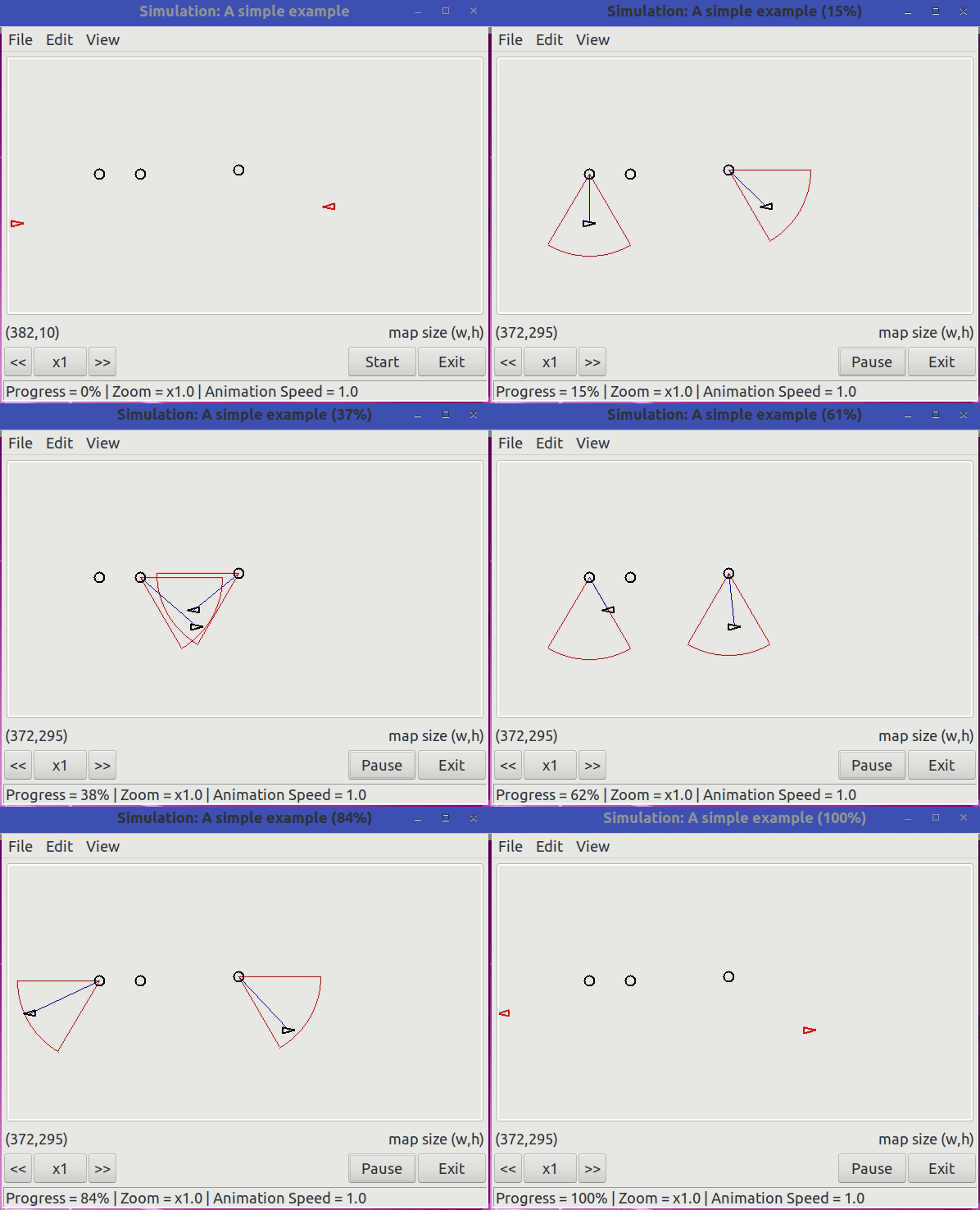
This is an example which demonstrates a cluster of sectorized BSs serving vehicles in a highway scenario. The mobility of vehicles is predefined and static in this example. The simulation will run for 10 seconds.
In this example, we use vehicle centric where vehicle will send a hello message to collect signal quality from all sectors of all BSs, and then associate with the sector with the highest quality (i.e. strongest SNR). The example shows how to use Transceiver class to send and detect signals, and measure the signal quality of a received signal.
Show source code
'''
This is an example which demonstrates a cluster of sectorized BSs serving vehicles in a
highway scenario. The mobility of vehicles is predefined and static in this example.
The simulation will run for 10 seconds.

In this example, we use vehicle centric where vehicle will send a hello message
to collect signal quality from all sectors of all BSs, and then associate with the sector
with the highest quality (i.e. strongest SNR). The example shows how to use Transceiver
class to send and detect signals, and measure the signal quality of a received signal.
'''

import wx
import operator
import argparse
from argparse import Namespace, ArgumentParser

from sim import World, BaseScenario, Event, ScreenXY as XY
from node import BaseNode, NodeType, Stationary, StaticPath
from comm import Transceiver, TransceiverDir, DiscModel

####################################################################
## Nodes
####################################################################

class MySector(BaseNode):
    '''
    MySector: This is a sector of a base station in the VANET sim world
    '''
    def __init__(self, simworld, id, loc, freq, channel, sector_width, sector_dir):
        super().__init__(simworld, id, node_type=NodeType.BaseStation(self))

        self.transceiver = TransceiverDir(self,freq,channel,sector_width,sector_dir)
        self.serving_node = None

        ## setup the sector
        self.set_transceiver(self.transceiver)
        self.set_mobility(Stationary(loc))

    ## show the coverage of this sector
    def show_coverage(self):
        self.clear_drawing() # this is persistent drawing, so need to clear the all first
        if self.serving_node!=None:
            if self.transceiver.get_property("type")=="omni":
                self.draw_circle(self.transceiver.get_property("radius"))
            elif self.transceiver.get_property("type")=="directional":
                self.draw_sector(self.transceiver.get_property("radius"),
                                 self.transceiver.get_property("azimuth"),
                                 self.transceiver.get_property("beam width"))

class MyVehicle(BaseNode):
    '''
    MyVehicle: This is a transmitting node in the VANET sim world
    '''
    def __init__(self, simworld, id, freq, channel):
        super().__init__(simworld, id, node_type=NodeType.Vehicle(self))

        ## initialize some properties
        self.transceiver = Transceiver(self,freq,channel)
        self.set_transceiver(self.transceiver)
        self.associated_sector = None

        ## initialize some variables to collect statistics
        self.connectivity = [ [None,0,0] ] # list of connections: [sector, start_time, end_time]

    ## associate with a sector
    def associate_sector(self,sector,time):
        self.associated_sector = sector
        sector.serving_node = self
        self.connectivity.append([sector,time,0])

    ## remove sector association due to lost of connection
    def lost_sector(self,time):
        self.associated_sector.serving_node = None
        self.associated_sector = None
        self.connectivity[len(self.connectivity)-1][2] = time

    ## draw a line to the associated sector, if any
    def show_connection(self):
        self.clear_drawing()
        if self.associated_sector!=None:
            self.draw_line(self.associated_sector)
            self.set_color(wx.BLACK)
        else:
            self.set_color(wx.RED)


####################################################################
## Scenario
####################################################################

class MyScenario(BaseScenario):
    '''
    MyScenario: This is my scenario
    '''

    ##---------------------------------------------------------------
    ## This method will be called before the start of the simulation,
    ## build the simulation world here
    def on_create(self, simworld) -> bool:

        ## give a name
        self.set_name("A simple example")

        ## create a common channel
        carrier_freq = 2.4
        coverage_range = 100
        beam_width = 60
        sector_dir = [180-60, 180, 180+60]
        ch_omni = DiscModel(coverage_range)

        ## create some nodes on the map
        bs_locs = [XY(110,140),XY(160,140),XY(280,135)] # locations
        self.sectors = []
        for i in range(0,len(bs_locs)): # BSs
            for j in range(0,len(sector_dir)): # sectors for each BS
                id = "BS-%d.%d"%(i+1,j+1)
                sector = MySector(simworld, id, bs_locs[i], carrier_freq, ch_omni,
                                  beam_width, sector_dir[j])
                self.sectors.append(sector)

        ## create some vehicles on the highway
        self.vehicles = []

        path = [ (60, XY(200,200)), (30, XY(400,200)) ]
        node = MyVehicle(simworld, id="Vehicle1", freq=carrier_freq, channel=ch_omni)
        node.set_mobility(StaticPath(start_loc=XY(10,200),path=path))
        self.vehicles.append(node)

        path = [ (40, XY(150,180)), (50, XY(5,180)) ]
        node = MyVehicle(simworld, id="Vehicle2", freq=carrier_freq, channel=ch_omni)
        node.set_mobility(StaticPath(start_loc=XY(390,180),path=path))
        self.vehicles.append(node)

        return True

    ##-------------------------------------------------------------
    ## This method will be called repeatedly until the simulation
    ## is ended or stopped, perform any user simulation action here
    def on_event(self, sim_time, event_obj):

        all_vehicles = self.vehicles
        all_sectors = self.sectors

        ## check vehicle connectivity with its associated sector
        for vehicle in all_vehicles:
            my_sector = vehicle.associated_sector
            if my_sector==None: continue # skip if none

            beacon = vehicle.transceiver.create_signal()
            if vehicle.transceiver.unicast(beacon,my_sector) is None: # lost connection
                vehicle.lost_sector(sim_time)
                print("at t=%1.2f, %s lost connection with %s"%(sim_time,vehicle.id,my_sector.id))

        ## make associatiation with sector if needed
        for vehicle in all_vehicles:

            ## step 1: check sector association, skip if already associated
            if vehicle.associated_sector!=None: continue

            ## step 2: find strongest SNR to associate
            sector_max = None
            detection_list = []
            beacon = vehicle.transceiver.create_signal()
            reply_list = vehicle.transceiver.broadcast(beacon)
            for (sector,signal) in reply_list:
                ## 2.1 check that the reachable node is a sector currently not serving other
                if sector.type!=NodeType.BaseStation: continue # skip if not a base station type
                if sector.serving_node!=None: continue # skip if sector is already serving other

                ## 2.2 sector beam replies beacon for vehicle to obtain the signal quality
                beacon_reply = sector.transceiver.create_signal()
                recv_signal = sector.transceiver.unicast(beacon_reply,vehicle)
                if recv_signal is None: continue # skip if failed, likely not in coverage

                ## 2.3 append to the detection list
                detection_list.append((sector,recv_signal.quality))

            ## step 3: associate with the sector with the strongest SNR, if exists
            if len(detection_list)!=0:
                sector_max = max(detection_list,key=operator.itemgetter(1))[0]
            if sector_max!=None:
                vehicle.associate_sector(sector_max,sim_time)
                print("at t=%1.2f, %s associated with %s"%(sim_time,vehicle.id,sector_max.id))

        ## draw connectivity & beam coverage on the map
        for vehicle in all_vehicles:
            vehicle.show_connection()
        for sector in all_sectors:
            sector.show_coverage()

        ## print statistics at the end of the simulation
        if event_obj==Event.SIM_END:
            print("\nStatistics (connected BS=duration):")
            conn_info_all = []
            average_all = []
            for vehicle in all_vehicles: # get statistics into `conn_info_all[]`
                conn_info_each = []
                sum_duration = 0
                connection_count = 0
                for conn in vehicle.connectivity:
                    if conn[0]==None: continue
                    conn_info_each.append([conn[0].id,conn[2]-conn[1]])
                    sum_duration += conn[2]-conn[1]
                    connection_count += 1
                conn_info_all.append(conn_info_each)
                average_all.append(sum_duration/connection_count)
            def print_fixed(text):
                print(f"   {text:15}",end='')
            for vehicle in all_vehicles: # line 1, heading
                print_fixed(vehicle.id)
            print("")
            max_record = 0
            for vehicle in all_vehicles: # line 2, separator
                print_fixed("-"*len(vehicle.id))
            print("")
            for record in conn_info_all: # line 3..., connection info
                if len(record)>max_record:
                    max_record = len(record)
            for idx in range(0,max_record):
                for vnode in range(0,len(conn_info_all)):
                    if idx<len(conn_info_all[vnode]):
                        print_fixed("%s=%1.2f"%(conn_info_all[vnode][idx][0],
                                                conn_info_all[vnode][idx][1]))
                    else:
                        print_fixed(" ")
                print("")
            for vehicle in all_vehicles:  # 2nd last line, separator
                print_fixed("-"*len(vehicle.id))
            print("")
            for average in average_all:   # last line, average values
                print_fixed("Mean=%1.2f"%average)
            print("")


####################################################################
## main
####################################################################

if __name__ == "__main__":

    ## command line parameters
    parser: ArgumentParser = argparse.ArgumentParser()
    parser.add_argument("--nodisplay", help="Run in no GUI mode", action="store_true")
    parser.add_argument("--step", help="Mobility step time (in sec)", type=int, default=0.1)
    parser.add_argument("--speed", help="Animation playback speed (x times)", type=float, default=1.0)
    parser.add_argument("--duration", help="Simulation duration (in sec), -1 for non-stop", type=int, default=10.0)
    args: Namespace = parser.parse_args()

    ## welcome info
    print("A Simple VANET Environment. Press [^C] to quit")

    if args.nodisplay:   print("- simulation will run without animation")
    else:                print("- animation will playback at x%1.2f speed"%args.speed)
    print("- vehicles move a step every %1.2f s in simulation"%args.step)
    if args.duration>0:  print("- simulation will stop at %1.2f s"%args.duration)
    else:                print("- simulation will run non-stop")

    ## create, setup and run the simulation
    ## note that to run a simulation, we need to create a 'scenario'
    run_flag = True
    while run_flag:
        sim = World()
        sim.config(sim_stop = args.duration,
                sim_step = args.step,
                sim_speed = args.speed,
                display_option = not args.nodisplay,
                scenario = MyScenario(sim))

        print("\nRunning PyMoSim version v%d.%d.%d"%sim.version())
        run_flag = sim.run()
Example 3
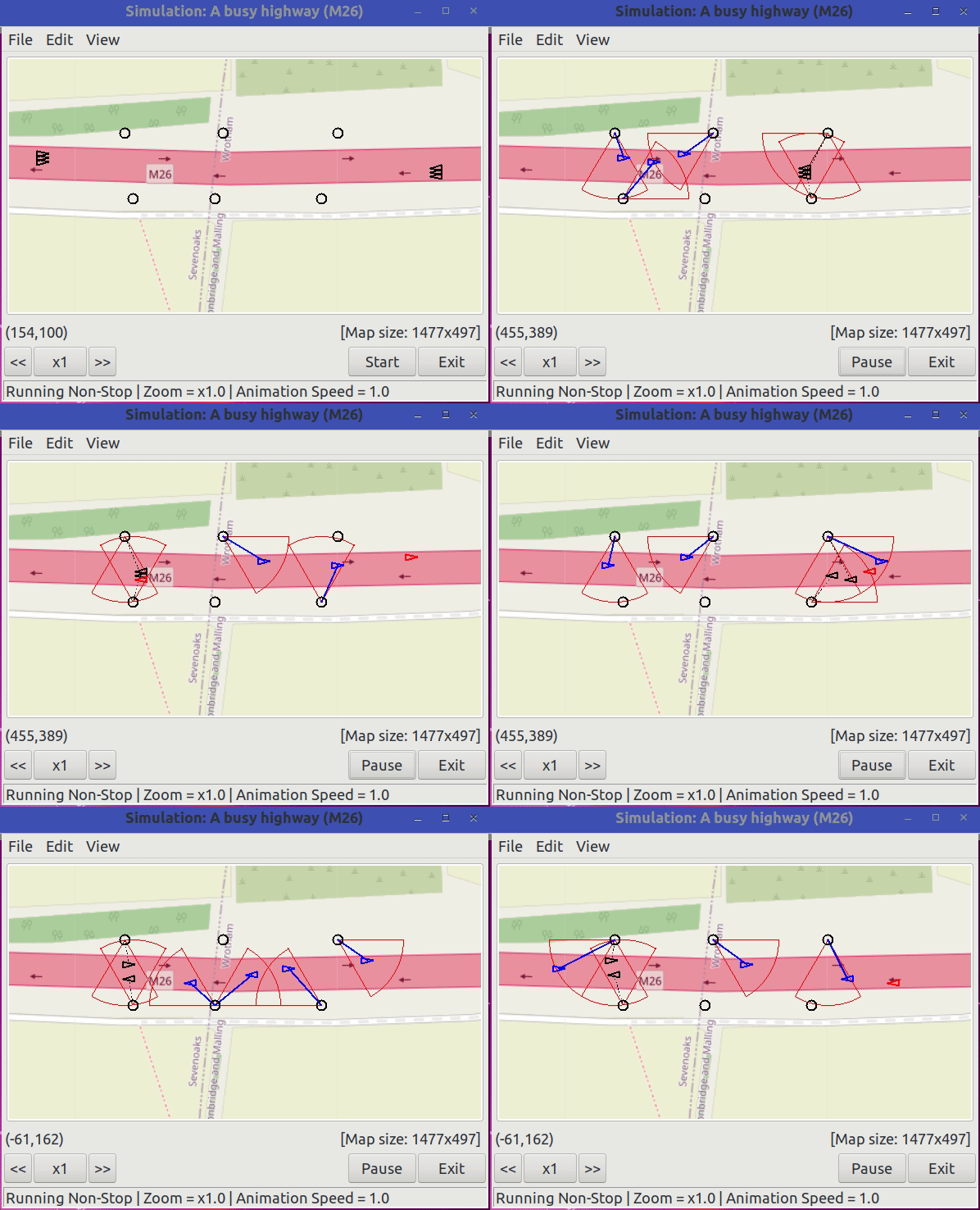
This is an example which demonstrates a cluster of mmWave BSs serving vehicles in a highway (M26) scenario. The background is a static image of M26 highway, and the mobility of the vehicles is carefully designed so that they appear moving on the highway. The simulation run continuously. Our design and assumptions are:
Vehicle Centric: Vehicle will send a hello beacon message to collect signal quality from all BS sectors, and then choose a sector to assiciate.
Strongest SNR: When choosing a BS to associate, the vehicle always pick the one with the highest signal quality (i.e. strongest SNR).
Simultaneous beams: A BS may have multiple radio heads (RHs), each RH radiates a beam on a sector. The BS can use all beams at the same time, each beam can serve a vehicle. If, say, the BS has 3 beams, and the condition is right, the BS can turn all beams active to serve 3 different vehicles at the same time.
Interference: If a vehicle is simultaneously covered by two active beams, interference occurs, and the transmission during that simulation time step is considered unsuccessful. We assume that the vehicle remains associated with the BS, but the transmission rate for that time step is zero.
Beam and channel model: There are two options in this example.
Option 1: Vehicles use omni-directional ideal Disc model, BSs use 6 ideal sectors. All 6 sectors combined give a perfect circle coverage. This is the default option.
Option 2: Vehicles use omni-directional Disc model, BSs use 28GHz mmWave beamforming to create 6 sectors.
Show source code
'''
This is an example which demonstrates a cluster of mmWave BSs serving vehicles
in a highway (M26) scenario. The background is a static image of M26 highway,
and the mobility of the vehicles is carefully designed so that they appear
moving on the highway.
The simulation run continuously. Our design and assumptions are:

- Vehicle Centric: Vehicle will send a hello beacon message to collect signal quality
  from all BS sectors, and then choose a sector to assiciate.
- Strongest SNR: When choosing a BS to associate, the vehicle always pick the one
  with the highest signal quality (i.e. strongest SNR).
- Simultaneous beams: A BS may have multiple radio heads (RHs), each RH radiates
  a beam on a sector. The BS can use all beams at the same time, each beam can serve
  a vehicle. If, say, the BS has 3 beams, and the condition is right, the BS can turn
  all beams active to serve 3 different vehicles at the same time.
- Interference: If a vehicle is simultaneously covered by two active beams,
  interference occurs, and the transmission during that simulation time step is
  considered unsuccessful. We assume that the vehicle remains associated with the
  BS, but the transmission rate for that time step is zero.
- Beam and channel model: There are two options in this example.

  - Option 1: Vehicles use omni-directional ideal Disc model, BSs use 6 ideal sectors.
    All 6 sectors combined give a perfect circle coverage. This is the default option.
  - Option 2: Vehicles use omni-directional Disc model, BSs use 28GHz mmWave beamforming
    to create 6 sectors.
'''

import wx
import operator
import argparse
import random
import math
from argparse import Namespace, ArgumentParser
from sim import World, BaseScenario, Event, ScreenXY as XY
from node import BaseNode, NodeType, Stationary, StaticPath
from comm import Transceiver, TransceiverDir, DiscModel

## for mmWave transmission, we need the following:
from comm.mmwave28 import Channel28GHz, Transceiver28GHz, Transceiver28GHzOmni

## pick option 1 or option 2
class GlobalVariable: pass
global_var = GlobalVariable()
global_var.option = 1  # option 1: ideal disc channel model
#global_var.option = 2  # option 2: mmWave beamforming model

####################################################################
## Helper
####################################################################

class DebugPrint:
    def print(self, *args, **kw):
        print(*args, **kw) # comment this line out to disable debug printing
        pass

####################################################################
## Nodes
####################################################################

class MySector(BaseNode):
    '''
    MySector: This is a base station in the VANET sim world implementing
    ideal sector radiation (option 1) or mmWave beamforming (option 2)
    '''
    def __init__(self, simworld, id, loc, freq, channel, sector_width, sector_dir):
        super().__init__(simworld, id, node_type=NodeType.BaseStation(self))

        ## create transceiver
        if global_var.option==1:
            self.transceiver = TransceiverDir(self,freq,channel,sector_width,sector_dir)
        elif global_var.option==2:
            ## convert sector_width to beam_3dB
            #  for 6 sectors, sector_width=60.  Based on 3GPP, beam_3dB = 35
            #  for 3 sectors, sector_width=120. Based on 3GPP, beam_3dB = 70
            #  so, beam_3dB = sector_width * 35/60 degree (to convert to rad)
            beam_3dB_rad = sector_width * 35/60 * math.pi/180

            ## setup the transceiver to create coverage range around 80
            self.transceiver = Transceiver28GHz(self, freq, channel,
                                        tx_power=20, # dBm
                                        gain_tx=2,   # dB
                                        beam_3dB=beam_3dB_rad,
                                        pointing_dir=sector_dir)

        self.serving_node = None

        ## setup the sector
        self.set_transceiver(self.transceiver)
        self.set_mobility(Stationary(loc))

    ## show the coverage of this sector
    def show_coverage(self):
        self.clear_drawing() # this is persistent drawing, so need to clear the all first
        if self.serving_node!=None:
            if self.transceiver.get_property("type")=="omni":
                self.draw_circle(self.transceiver.get_property("radius"))
            elif (self.transceiver.get_property("type")=="directional"
                or self.transceiver.get_property("type")=="mmWaveBeam"):
                self.draw_sector(self.transceiver.get_property("radius"),
                                 self.transceiver.get_property("azimuth"),
                                 self.transceiver.get_property("beam width"))


class MyVehicle(BaseNode):
    '''
    MyVehicle: This is a transmitting node in the VANET sim world
    '''
    def __init__(self, simworld, id, freq, channel):
        super().__init__(simworld, id, node_type=NodeType.Vehicle(self))

        ## create transceiver
        if global_var.option==1:
            self.transceiver = Transceiver(self,freq,channel)
        elif global_var.option==2:
            self.transceiver = Transceiver28GHzOmni(self, freq, channel,
                                        tx_power=20, # dBm
                                        gain_tx=2)   # dB

        self.set_transceiver(self.transceiver)
        self.associated_sector = None
        self.has_interference = False

        self.curr_conn = 0
        self.connectivity = [ [None,0,0] ] # list of connections: [sector, start_time, end_time]

    def associate_sector(self,sector,time):
        self.associated_sector = sector
        sector.serving_node = self
        self.connectivity.append([sector,time,0])
        self.curr_conn += 1

    def lost_sector(self,time):
        self.associated_sector.serving_node = None
        self.associated_sector = None
        self.connectivity[self.curr_conn][2] = time

    ## draw a line to the associated sector, if any
    def show_connection(self):
        self.clear_drawing() # this is persistent drawing, so need to clear the all first
        if self.associated_sector!=None:
            if self.has_interference:
                # vehicle with a sector & has interference
                self.set_color(wx.BLACK)
                self.draw_line(self.associated_sector,pen = wx.Pen(wx.BLACK,1,style=wx.PENSTYLE_SHORT_DASH))
            else:
                # vehicle with a sector & has no interference
                self.draw_line(self.associated_sector,pen = wx.Pen(wx.BLUE,2,style=wx.PENSTYLE_SOLID))
                self.set_color(wx.BLUE)
        else:
            # vehicle without a sector association
            self.set_color(wx.RED)

####################################################################
## Scenario
####################################################################

class MyScenario(BaseScenario,DebugPrint):
    '''
    MyScenario: This is my scenario
    '''

    ## ------------------------------------------------------------
    ## This method will be called before the start of the simulation,
    ## build the simulation world here
    def on_create(self, simworld) -> bool:

        ## simulation variables
        self.simworld = simworld
        if self.simworld.is_animation_shown():
            bitmap = wx.Bitmap()
            if bitmap.LoadFile("M26.png"):
                self.set_background(bitmap,-500,0)
            else:
                print("Error loading bitmap file, no background is applied.")
        self.set_name("A busy highway (M26)")

        ## configure tranceiver property for each BS sector
        beam_radius = 80
        beam_num = 6      # must be an integer
        beam_width = 360/beam_num
        beam_pointing = 0 # 0 means north
        sector = {}
        for i in range(0,beam_num):
            angle = beam_pointing + i*beam_width
            while angle>=360: angle-=360
            sector[i] = {"angle":angle, "width":beam_width}

        ## create channel for signal propagation model
        carrier_freq = 28 # GHz
        ch_disc = DiscModel(beam_radius)
        ch_28GHz = Channel28GHz()
        if global_var.option==1:   channel_model = ch_disc
        elif global_var.option==2: channel_model = ch_28GHz
        else:
            print("Error: Wrong option\n")
            return False

        ## create some nodes on the north and south sides of the highway
        bs_locs = [XY(110,260),XY(210,260),XY(340,260)] # south locations
        bs_locs += [XY(100,180),XY(220,180),XY(360,180)] # north locations
        self.bs_nodes = []
        for i in range(0,len(bs_locs)): # each BS location
            for j in range(0,len(sector)): # create sectors for each BS
                this_id = "BS%d.%d"%(i,j)
                this_node = MySector(simworld, this_id, bs_locs[i],
                                        carrier_freq, channel_model,
                                        sector_width=sector[j]["width"],
                                        sector_dir=sector[j]["angle"])
                self.bs_nodes.append(this_node)

        ## setup vehicle info
        self.vehicle_info = {}  # list of [start location, end location]
        y = 205; space=5
        self.vehicle_info["car1"] = [XY(0,y), XY(480,y)]; y+=space
        self.vehicle_info["car2"] = [XY(0,y), XY(480,y)]; y+=space
        self.vehicle_info["car3"] = [XY(0,y), XY(480,y)]; y+=space+3
        self.vehicle_info["car4"] = [XY(480,y), XY(0,y)]; y+=space
        self.vehicle_info["car5"] = [XY(480,y), XY(0,y)]; y+=space
        self.vehicle_info["car6"] = [XY(480,y), XY(0,y)]; y+=space

        ## create the vehicles on the highway based on above info
        self.vehicles = []
        for info in self.vehicle_info:
            start_loc = self.vehicle_info[info][0]
            end_loc = self.vehicle_info[info][1]
            path = [ (random.uniform(30,60), end_loc) ]
            node = MyVehicle(simworld, id=info, freq=carrier_freq, channel=channel_model)
            node.set_mobility(StaticPath(start_loc=start_loc,path=path))
            self.vehicles.append(node)

        # put the following into the class property, needed in `do_restart_node()`
        self.freq = carrier_freq
        self.ch_model = channel_model
        return True

    ## --------------------------------------------------------
    ## This method will be called repeatedly until the simulation
    ## is ended or stopped, perform any simulation action here
    def on_event(self, sim_time, event_obj):

        if event_obj==Event.MOBILITY_END: # a mobile node has finished its mobility?
            self.do_restart_node(sim_time,event_obj)
        elif event_obj==Event.SIM_MOBILITY: # mobility progresses a time step?
            self.do_mobility(sim_time,event_obj)

    ## end of mobility, then create a new vehicle to replace this one
    def do_restart_node(self, sim_time, event_obj):
        this_node = event_obj.get("node") # get the node reaching end of mobility

        speed = random.uniform(30,60)                  # new speed
        start_loc = self.vehicle_info[this_node.id][0] # new start location
        end_loc = self.vehicle_info[this_node.id][1]   # new end location
        new_path = [ (speed, end_loc) ]                # build a new path
        new_node = MyVehicle(self.simworld, id=this_node.id,
                             freq=self.freq, channel=self.ch_model)
        new_node.set_mobility(StaticPath(start_loc=start_loc,path=new_path))
        self.vehicles.append(new_node) # add new node to our list

        self.vehicles.remove(this_node) # remove old node from our list
        this_node.remove_from_simulation() # remove old node from the simulation

    ## Do user simulation here
    ## main task: do BS association if needed
    def do_mobility(self, sim_time, event_obj):

        all_vehicles = self.vehicles    # get all vehicles from our liist
        all_sectors = self.bs_nodes     # get all sectors from our list

        ## check vehicle connectivity with its associated BS
        for vehicle in all_vehicles:
            my_sector = vehicle.associated_sector
            if my_sector==None: continue # skip if none

            beacon = vehicle.transceiver.create_signal()
            if vehicle.transceiver.unicast(beacon,my_sector) is None: # lost connection
                vehicle.lost_sector(sim_time)
                self.print("at t=%1.2f, %s lost connection with %s"%(sim_time,vehicle.id,my_sector.id))

        ## main task: make associatiation with BS if needed
        for vehicle in all_vehicles:

            ## step 1: check sector association, skip if already associated
            if vehicle.associated_sector!=None: continue

            ## step 2: find strongest SNR to associate
            bs_max = None
            detection_list = []
            beacon = vehicle.transceiver.create_signal()
            reply_list = vehicle.transceiver.broadcast(beacon)
            for (beam,signal) in reply_list:
                ## 2.1 check that the reachable node is a BS sector currently not serving other
                if beam.type!=NodeType.BaseStation: continue # skip if not BS sector
                if beam.serving_node!=None: continue # skip if BS sector is already serving other

                ## 2.2 sector beam replies beacon for vehicle to obtain the signal quality
                beacon_reply = beam.transceiver.create_signal()
                recv_signal = beam.transceiver.unicast(beacon_reply,vehicle)
                if recv_signal is None: continue # skip if failed, likely not in coverage

                ## 2.3 append to the detection list
                detection_list.append((beam,recv_signal.quality))

            ## step 3: associate with the BS with the strongest SNR, if exists
            if len(detection_list)!=0:
                bs_max = max(detection_list,key=operator.itemgetter(1))[0]
            if bs_max!=None:
                vehicle.associate_sector(bs_max,sim_time)
                self.print("at t=%1.2f, %s associated with %s"%(sim_time,vehicle.id,bs_max.id))

        ## check for interference for each vehicle
        for vehicle in all_vehicles:

            ## skip if no BS association, probably outside of BS beam coverage
            if vehicle.associated_sector==None: continue

            ## use hello-beacon to find which other beam also covers this vehicle
            vehicle.has_interference = False
            beacon = vehicle.transceiver.create_signal()
            reply_list = vehicle.transceiver.broadcast(beacon)
            for (beam,signal) in reply_list:

                ## check the bs beam
                if beam.type!=NodeType.BaseStation: continue # skip if not BS
                if beam.serving_node==None: continue         # skip if the bs is not active
                if beam==vehicle.associated_sector: continue # skip if it's the associated BS

                ## at this point, the beam is associated with another vehicle
                ## check that if it can also cover this vehicle
                probe_message = beam.transceiver.create_signal()
                recv_signal = beam.transceiver.unicast(probe_message,vehicle)
                if recv_signal is not None:      # can probe signal reach the vehicle?
                    vehicle.has_interference = True  # if so, set interference to True

        ## draw connectivity & beam coverage on the map
        for vehicle in all_vehicles:
            vehicle.show_connection()
        for beam in all_sectors:
            beam.show_coverage()


####################################################################
## main
####################################################################

if __name__ == "__main__":

    ## command line parameters
    parser: ArgumentParser = argparse.ArgumentParser()
    parser.add_argument("--nodisplay", help="Run in no GUI mode", action="store_true")
    parser.add_argument("--step", help="Mobility step time (in sec)", type=int, default=0.2)
    parser.add_argument("--speed", help="Animation playback speed (x times)", type=float, default=1.0)
    parser.add_argument("--duration", help="Simulation duration (in sec), -1 for non-stop", type=int, default=1)
    args: Namespace = parser.parse_args()

    ## welcome info
    print("A Simple VANET Environment. Press [^C] to quit")
    #args.nodisplay = True  # <-- hardcoding no GUI mode
    args.step = 0.1         # <-- hardcoding the mobility step time
    args.speed = 1.0        # <-- hardcoding the animation speed (times)
    args.duration = -1     # <-- hardcoding the sim duration (sec)

    if args.nodisplay:   print("- simulation will run without animation")
    else:                print("- animation will playback at x%1.2f speed"%args.speed)
    print("- vehicles move a step every %1.2f s in simulation"%args.step)
    if args.duration>0:  print("- simulation will stop at %1.2f s"%args.duration)
    else:                print("- simulation will run non-stop")

    ## create, setup and run the simulation
    ## note that to run a simulation, we need to create a 'scenario'
    run_flag = True
    while run_flag:
        sim = World()
        sim.config(sim_stop = args.duration,
                sim_step = args.step,
                sim_speed = args.speed,
                display_option = not args.nodisplay,
                scenario = MyScenario(sim))

        print("\nRunning PyMoSim version v%d.%d.%d"%sim.version())
        run_flag = sim.run()
Example 4
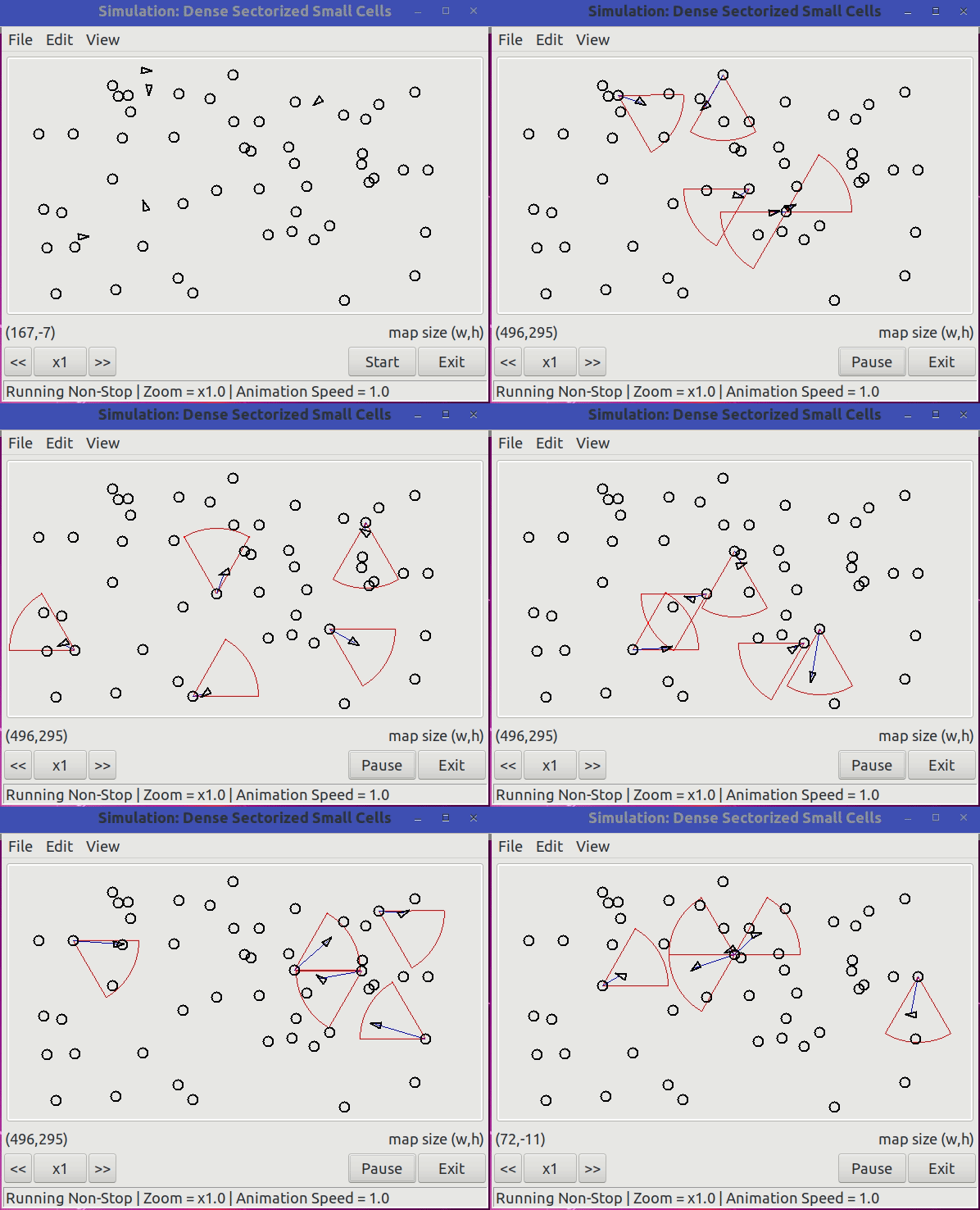
This is an example demonstrating a number of vehicles following random waypoint mobility moving on the map which contains a number of sectorized small cell base stations. The simulation runs non-stop.
In this example, we use vehicle centric where vehicle will send a hello beacon message to collect reply packet quality from all sectors of all BSs, and then associate with the sector with the highest quality (i.e. strongest SNR).
Show source code
'''
This is an example demonstrating a number of vehicles following random waypoint
mobility moving on the map which contains a number of sectorized small cell base
stations. The simulation runs non-stop.

In this example, we use vehicle centric where vehicle will send a hello beacon message
to collect reply packet quality from all sectors of all BSs, and then associate with
the sector with the highest quality (i.e. strongest SNR).
'''

import wx
import operator
import argparse
import random
from argparse import Namespace, ArgumentParser

from sim import World, BaseScenario, Event, ScreenXY as XY
from node import BaseNode, NodeType, Stationary, StaticPath
from comm import Transceiver, TransceiverDir, DiscModel

####################################################################
## Helper
####################################################################

class DebugPrint:
    def print(self, *args, **kw):
        print(*args, **kw) # comment this line out to disable debug printing
        pass


####################################################################
## Nodes
####################################################################

class MySector(BaseNode):
    '''
    MySector: This is a sector of a base station in the VANET sim world
    '''
    def __init__(self, simworld, id, loc, freq, channel, sector_width, sector_dir):
        super().__init__(simworld, id, node_type=NodeType.BaseStation(self))

        self.transceiver = TransceiverDir(self,freq,channel,sector_width,sector_dir)
        self.serving_node = None

        ## setup the sector
        self.set_transceiver(self.transceiver)
        self.set_mobility(Stationary(loc))

    ## show the coverage of this sector
    def show_coverage(self):
        self.clear_drawing() # this is persistent drawing, so need to clear the all first
        if self.serving_node!=None:
            if self.transceiver.get_property("type")=="omni":
                self.draw_circle(self.transceiver.get_property("radius"))
            elif self.transceiver.get_property("type")=="directional":
                self.draw_sector(self.transceiver.get_property("radius"),
                                 self.transceiver.get_property("azimuth"),
                                 self.transceiver.get_property("beam width"))

class MyVehicle(BaseNode):
    '''
    MyVehicle: This is a transmitting node in the VANET sim world
    '''
    def __init__(self, simworld, id, freq, channel):
        super().__init__(simworld, id, node_type=NodeType.Vehicle(self))

        ## initialize some properties
        self.transceiver = Transceiver(self,freq,channel)
        self.set_transceiver(self.transceiver)
        self.associated_sector = None

        ## initialize some variables to collect statistics
        self.connectivity = [ [None,0,0] ] # list of connections: [sector, start_time, end_time]

    ## associate with a sector
    def associate_sector(self,sector,time):
        self.associated_sector = sector
        sector.serving_node = self
        self.connectivity.append([sector,time,0])

    ## remove sector association due to lost of connection
    def lost_sector(self,time):
        self.associated_sector.serving_node = None
        self.associated_sector = None
        self.connectivity[len(self.connectivity)-1][2] = time
        if len(self.connectivity)>20: # keep last 20 records
            self.connectivity.pop(0)

    ## draw a line to the associated sector, if any
    def show_connection(self):
        self.clear_drawing()
        if self.associated_sector!=None:
            self.draw_line(self.associated_sector)
            self.set_color(wx.BLACK)
        else:
            self.set_color(wx.RED)


####################################################################
## Scenario
####################################################################

class MyScenario(BaseScenario,DebugPrint):
    '''
    MyScenario: This is my scenario
    '''

    ## This method will be called before the start of the simulation,
    ## build the simulation world here
    def on_create(self, simworld) -> bool:

        ## simulation title
        self.set_name("Dense Sectorized Small Cells")

        ## simulation setup for beam
        beam_radius = 80
        beam_num = 6     # must be an integer
        beam_width = 360/beam_num
        beam_pointing = 0 # 0 means north

        ## simulation setup for map
        self.map_width = 500 # pixels
        self.map_height = 300 # pixels

        ## simulation setup for nodes
        bs_num = 50 # number of BSs to put on the map
        car_num = 5 # number of vehicles to put on the map

        ## simulation setup for channel
        carrier_freq = 2.4
        ch_omni = DiscModel(beam_radius)
        sector_dir = []
        for i in range(0,beam_num):
            angle = beam_pointing + i*beam_width
            while angle>=360: angle-=360
            sector_dir.append(angle)

        ## create BSs and their sectors on the map at random locations
        self.sector_nodes = []
        for i in range(0,bs_num):
            loc = self.get_random_loc()
            for j in range(0,beam_num): # create sectors for each BS
                this_id = "BS%d.%d"%(i,j)
                this_node = MySector(simworld, this_id, loc, carrier_freq, ch_omni,
                                     beam_width, sector_dir[j])
                self.sector_nodes.append(this_node)

        ## create some vehicles on the map
        self.vehicles = []
        for i in range(0,car_num):
            path = [ (random.uniform(40,60), self.get_random_loc()) ]
            node = MyVehicle(simworld, id="Vehicle%d"%i,freq=carrier_freq,channel=ch_omni)
            node.set_mobility(StaticPath(start_loc=self.get_random_loc(),path=path))
            self.vehicles.append(node)

        return True

    ## generate a random location
    def get_random_loc(self):
        x = int(random.random() * self.map_width)
        y = int(random.random() * self.map_height)
        return XY(x,y)

    ## This method will be called repeatedly until the simulation is ended/stopped
    def on_event(self, sim_time, event_obj):

        if event_obj==Event.MOBILITY_END: # a mobile node has finished its mobility?
            self.do_create_path(sim_time,event_obj)
        elif event_obj==Event.SIM_MOBILITY: # mobility progresses a time step?
            self.do_mobility(sim_time,event_obj)
        elif (event_obj==Event.SIM_END
              or event_obj==Event.SIM_STOP): # end of simulation?
            self.print_statistics()

    ## create a new path for the node
    def do_create_path(self, sim_time, event_obj):
        speed = random.uniform(30,60) # random speed
        loc = self.get_random_loc()   # random location
        node = event_obj.get("node")
        node.get("mobility").reset_path(speed,loc)

    ## Do user simulation here
    def do_mobility(self, sim_time, event_obj):

        all_vehicles = self.vehicles
        all_sectors = self.sector_nodes

        ## check vehicle connectivity with its associated sector
        for vehicle in all_vehicles:
            my_sector = vehicle.associated_sector
            if my_sector==None: continue # skip if none

            beacon = vehicle.transceiver.create_signal()
            if vehicle.transceiver.unicast(beacon,my_sector) is None: # lost connection
                vehicle.lost_sector(sim_time)

        ## make associatiation with sector if needed
        for vehicle in all_vehicles:

            ## step 1: check BS sector association, skip if already associated
            if vehicle.associated_sector!=None: continue

            ## step 2: find strongest SNR to associate
            sector_max = None
            detection_list = []
            beacon = vehicle.transceiver.create_signal()
            reply_list = vehicle.transceiver.broadcast(beacon)
            for (sector,signal) in reply_list:
                ## 2.1 check that the reachable node is a BS currently not serving other
                if sector.type!=NodeType.BaseStation: continue # skip if not a base station type
                if sector.serving_node!=None: continue # skip if sector is already serving other

                ## 2.2 sector beam replies beacon for vehicle to obtain the signal quality
                beacon_reply = sector.transceiver.create_signal()
                recv_signal = sector.transceiver.unicast(beacon_reply,vehicle)
                if recv_signal is None: continue # skip if failed, likely not in coverage

                ## 2.3 append to the detection list
                detection_list.append((sector,recv_signal.quality))

            ## step 3: associate with the BS sector with the strongest SNR, if exists
            if len(detection_list)!=0:
                sector_max = max(detection_list,key=operator.itemgetter(1))[0]
            if sector_max!=None:
                vehicle.associate_sector(sector_max,sim_time)

        ## draw connectivity & sector coverage on the map
        for vehicle in all_vehicles:
            vehicle.show_connection()
        for sector in all_sectors:
            sector.show_coverage()


    ## This method prints statistics of the connectivity durations
    ## This should be called at the end of the simulation
    def print_statistics(self):

        print("\nStatistics (last 20 connected BSs and the duration):")
        all_vehicles = self.vehicles

        conn_info_all = []
        average_all = []
        for vehicle in all_vehicles: # get statistics into `conn_info_all[]`
            conn_info_each = []
            sum_duration = 0
            connection_count = 0
            for conn in vehicle.connectivity:
                if conn[0]==None: continue
                duration = conn[2]-conn[1]
                if duration<=0: continue # unfinished record (due to sim_end)
                conn_info_each.append([conn[0].id,duration])
                sum_duration += duration
                connection_count += 1
            conn_info_all.append(conn_info_each)
            if connection_count!=0:
                average_all.append(sum_duration/connection_count)
            else:
                average_all.append(0)
        def print_fixed(text):
            print(f"   {text:15}",end='')
        for vehicle in all_vehicles: # line 1, heading
            print_fixed(vehicle.id)
        print("")
        max_record = 0
        for vehicle in all_vehicles: # line 2, separator
            print_fixed("-"*len(vehicle.id))
        print("")
        for record in conn_info_all: # line 3..., connection info
            if len(record)>max_record:
                max_record = len(record)
        for idx in range(0,max_record):
            for vnode in range(0,len(conn_info_all)):
                if idx<len(conn_info_all[vnode]):
                    print_fixed("%s=%1.2f"%(conn_info_all[vnode][idx][0],
                                            conn_info_all[vnode][idx][1]))
                else:
                    print_fixed(" ")
            print("")
        for vehicle in all_vehicles:  # 2nd last line, separator
            print_fixed("-"*len(vehicle.id))
        print("")
        for average in average_all:   # last line, average values
            print_fixed("Mean=%1.2f"%average)
        print("")


####################################################################
## main
####################################################################

if __name__ == "__main__":

    ## command line parameters
    parser: ArgumentParser = argparse.ArgumentParser()
    parser.add_argument("--nodisplay", help="Run in no GUI mode", action="store_true")
    parser.add_argument("--step", help="Mobility step time (in sec)", type=int, default=0.2)
    parser.add_argument("--speed", help="Animation playback speed (x times)", type=float, default=1.0)
    parser.add_argument("--duration", help="Simulation duration (in sec)", type=int, default=1)
    args: Namespace = parser.parse_args()

    ## welcome info
    print("A Simple VANET Environment. Press [^C] to quit")
    #args.nodisplay = True  # <-- hardcoding no GUI mode
    args.step = 0.1         # <-- hardcoding the mobility step time
    args.speed = 1.0        # <-- hardcoding the animation speed (times)
    args.duration = -1      # <-- hardcoding the sim duration (sec)

    if args.nodisplay:   print("- simulation will run without animation")
    else:                print("- animation will playback at x%1.2f speed"%args.speed)
    print("- vehicles move a step every %1.2f s in simulation"%args.step)
    if args.duration>0:  print("- simulation will stop at %1.2f s"%args.duration)
    else:                print("- simulation will run non-stop")

    ## create, setup and run the simulation
    ## note that to run a simulation, we need to create a 'scenario'
    run_flag = True
    while run_flag:
        sim = World()
        sim.config(sim_stop = args.duration,
                sim_step = args.step,
                sim_speed = args.speed,
                display_option = not args.nodisplay,
                scenario = MyScenario(sim))

        print("\nRunning PyMoSim version v%d.%d.%d"%sim.version())
        run_flag = sim.run()
Example 5
This example demonstrates the use of comm.transceiver.UserTransceiver.
It uses comm.signalwave.QualityBasedSignal for transmission. It
illustrates how users can implement own signal propagation and detection logic.
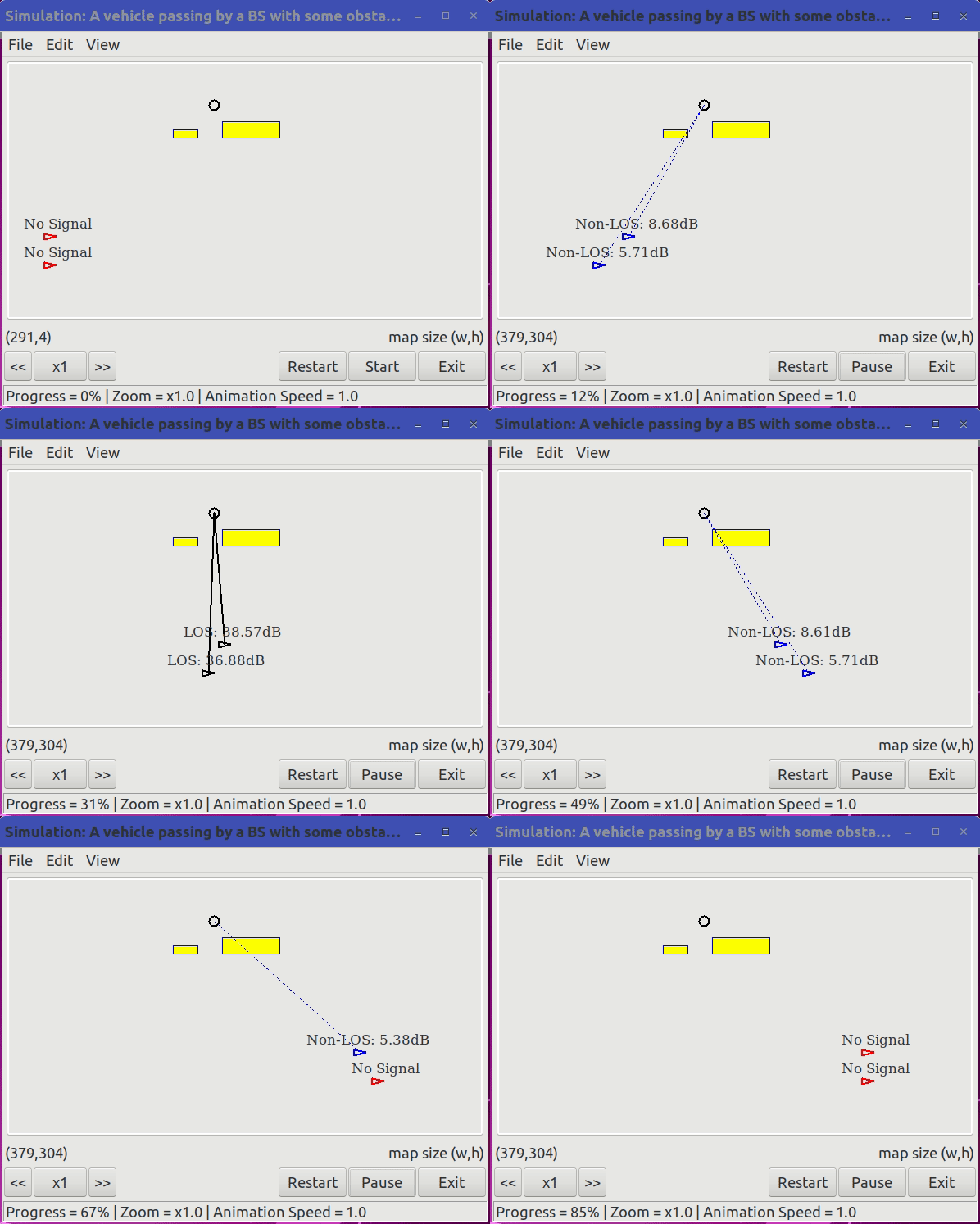
In this example, we have two moving vehicles and we let the base station (BS) connect to both if they can detect the signal from the BS. This example shows how signal propagation and detection logic can be implemented at the user simulation level if users need some special treatment and full control of signal propagation and signal detection logic.
We assume that the BS can track vehicles. The channel model is based on [WFY20].
References
- WFY20
P. Wang, J. Fang, X. Yuan, Z. Chen, and H. Li, “Intelligent reflecting surface-assisted millimeter wave communications: Joint active and passive precoding design,” IEEE Transactions on Vehicular Technology, vol. 69, no. 12, pp. 14960-14973, 2020.
Show source code
'''
This example demonstrates the use of :class:`comm.transceiver.UserTransceiver`.
It uses :class:`comm.signalwave.QualityBasedSignal` for transmission. It
illustrates how users can implement own signal propagation and detection logic.

In this example, we have two moving vehicles and we let the base station
(BS) connect to both if they can detect the signal from the BS.
This example shows how signal propagation and detection logic can be
implemented at the user simulation level if users need some special treatment
and full control of signal propagation and signal detection logic.

We assume that the BS can track vehicles. The channel model is based on [WFY20]_.

References
----------
.. [WFY20] P. Wang, J. Fang, X. Yuan, Z. Chen, and H. Li, "Intelligent
    reflecting surface-assisted millimeter wave communications: Joint
    active and passive precoding design," IEEE Transactions on Vehicular
    Technology, vol. 69, no. 12, pp. 14960-14973, 2020.
'''

import wx
import math
import argparse
from argparse import Namespace, ArgumentParser
from typing import Dict, List, Tuple

from sim import World, BaseScenario, Drawable, Dir2D, ScreenXY as XY
from node import BaseNode, NodeType, Obstacle, Stationary, StaticPath
from comm import UserTransceiver

####################################################################
## My Transceiver
## - Perform own signal propagation and detection logic
## - Aware of an obstacle
####################################################################

class MyTransceiver(UserTransceiver):

    ## class constants or default values
    noise = -90 # dBm
    snr_threshold = 5 # dB

    def __init__(self, node, freq, tx_power, ant_element):
        super().__init__(node,freq)
        self.obstacle_list = None
        self.tx_power = tx_power
        self.ant_element = ant_element
        self.snr_threshold = MyTransceiver.snr_threshold

    def create_signal(self, tx_power=None):
        '''Use this method to create a signal.

        Parameters
        ----------
        tx_power : float
            The transmit power of the signal.

        Returns
        -------
        :class:`comm.signalwave.QualityBasedSignal`
            The created signal to be used for transmission.
        '''
        signal = super().create_signal()
        if tx_power is None: signal.tx_power = self.tx_power
        signal.add_info("ant element",self.ant_element) # number of antenna elements
        return signal

    def set_obstacle(self, obstacle_list):
        self.obstacle_list = obstacle_list

    def is_crossed_obstacle(self, tx_loc, rx_loc) -> bool:
        if self.obstacle_list is None: return False
        point1 = tx_loc.get_xy()
        point2 = rx_loc.get_xy()
        return self.obstacle_list.is_crossed(point1,point2)

    def can_detect(self, the_signal) -> bool:
        '''This is the function to perform signal propagation and
        detection logic.'''

        ## retrieve all key info first
        tx_power = the_signal.tx_power      # get the tx power in dBm
        distance = the_signal.distance      # get the distance travelled
        travelling_dir = the_signal.LOS_dir # get the travelling direction
        tx_loc = the_signal.source._node.get("location") # sender location
        rx_loc = self._node.get("location")              # receiver location

        ## check if signal is crossing obstacle
        is_crossed = self.is_crossed_obstacle(tx_loc,rx_loc)

        ## apply simple passloss model c0*d^(-α), where
        #  - d is the distance, in our system, 2 pixels = 1m, minimum 1m
        #  - α is the pathloss exponent, 2 for normal, 2.92 when crossing an obstacle
        #  - c0 is the gain/loss
        ## pathloss PL_db = log10(c0) + 10α*log10(d)
        distance /= 2             # convert pixel-to-meter
        if distance<1: distance=1 # min 1m
        alpha = 2 if not is_crossed else 2.92   # set pathloss exponent
        log_c0 = 61.4 if not is_crossed else 72 # set loss
        pathloss_db = log_c0 + 10*alpha*math.log10(distance)

        ## received power including the gain from the number of antenna elements
        ant_element_num = the_signal.get_info("ant element")
        received_power = tx_power - pathloss_db + 10*math.log10(ant_element_num)

        ## check if the signal is detectable, i.e. its SNR
        ## exceeds the threshold (default setting, see `MyTransceiver.snr_threshold`)
        snr = received_power-MyTransceiver.noise
        if snr>=MyTransceiver.snr_threshold:
            the_signal.quality = received_power
            the_signal.add_info("crossed_obstacle",is_crossed)
            return True # can detect
        else:
            the_signal.quality = None
            return False # cannot detect

class MyTransceiverBS(MyTransceiver):
    def __init__(self, node):
        super().__init__(node, freq=28, tx_power=30, ant_element=64)

class MyTransceiverVehicle(MyTransceiver):
    def __init__(self, node):
        super().__init__(node, freq=28, tx_power=20, ant_element=1)

####################################################################
## Nodes
####################################################################

class MyBS(BaseNode):
    '''
    MyBS: This is a base station in the VANET sim world implementing
    a user-defined transceiver.
    '''
    def __init__(self, simworld, id, loc):
        super().__init__(simworld, id, node_type=NodeType.BaseStation(self))

        self.transceiver = MyTransceiverBS(self)

        ## setup the BS
        self.set_transceiver(self.transceiver)
        self.set_mobility(Stationary(loc))

class MyVehicle(BaseNode):
    '''
    MyVehicle: This is a transmitting node in the VANET sim world implementing
    a user-defined transceiver.
    '''
    def __init__(self, simworld, id):
        super().__init__(simworld, id, node_type=NodeType.Vehicle(self))

        ## initialize some properties
        self.transceiver = MyTransceiverVehicle(self)
        self.set_transceiver(self.transceiver)

        self.associated_bs = None
        self.connection_quality = None
        self.crossed_obstacle = False

    ## draw a line to the connected BS, if any
    def show_connection(self):
        self.clear_drawing()
        if self.associated_bs is not None:
            self.associated_bs.clear_drawing()
            if self.crossed_obstacle:
                self.draw_line(self.associated_bs,pen = wx.Pen(wx.BLUE,1,style=wx.PENSTYLE_SHORT_DASH))
                self.set_color(wx.BLUE)
                self.draw_text(10,-15,"Non-LOS: %1.2fdB"%(self.connection_quality-MyTransceiver.noise),
                                wx.Font(10, wx.FONTFAMILY_ROMAN, wx.FONTSTYLE_NORMAL,
                                            wx.FONTWEIGHT_NORMAL))
            else:
                self.draw_line(self.associated_bs,pen = wx.Pen(wx.BLACK,2,style=wx.PENSTYLE_SOLID))
                self.set_color(wx.BLACK)
                self.draw_text(10,-15,"LOS: %1.2fdB"%(self.connection_quality-MyTransceiver.noise),
                                wx.Font(10, wx.FONTFAMILY_ROMAN, wx.FONTSTYLE_NORMAL,
                                            wx.FONTWEIGHT_NORMAL))
        else:
            self.set_color(wx.RED)
            self.draw_text(10,-15,"No Signal",
                            wx.Font(10, wx.FONTFAMILY_ROMAN, wx.FONTSTYLE_NORMAL,
                                        wx.FONTWEIGHT_NORMAL))


####################################################################
## Scenario
####################################################################

class MyScenario(BaseScenario):
    '''
    MyScenario: This is my scenario.
    '''
    ##---------------------------------------------------------------
    ## This method will be called before the start of the simulation,
    ## build the simulation world here
    def on_create(self, simworld) -> bool:

        ## give a name
        self.set_name("A vehicle passing by a BS with some obstacles")

        ## create two obstacles
        self.my_obstacle_list = Obstacle()
        self.my_obstacle_list.add_rect(x=260, y=70, w=70, h=20)
        self.my_obstacle_list.add_rect(x=200, y=80, w=30, h=10)
        for each_block in self.my_obstacle_list.get_list():
            self.add_drawable(Drawable().polygon(each_block)
                                        .set_drawing(wx.BLUE_PEN,wx.YELLOW_BRUSH))

        ## create a BS on the map
        self.bs = MyBS(simworld, "BS", XY(250,50))
        self.bs.transceiver.set_obstacle(self.my_obstacle_list)

        ## create several passing vehicles
        self.vehicles = []

        path = [ (60, XY(200,210)), (30, XY(450,210)) ]
        node = MyVehicle(simworld, "Vehicle1")
        node.set_mobility(StaticPath(start_loc=XY(50,210),path=path))
        node.transceiver.set_obstacle(self.my_obstacle_list)
        self.vehicles.append(node)

        path = [ (40, XY(200,245)), (50, XY(450,245)) ]
        node = MyVehicle(simworld, "Vehicle2")
        node.set_mobility(StaticPath(start_loc=XY(50,245),path=path))
        node.transceiver.set_obstacle(self.my_obstacle_list)
        self.vehicles.append(node)

        return True

    ##-------------------------------------------------------------
    ## This method will be called repeatedly until the simulation
    ## is ended or stopped, perform any user simulation action here
    def on_event(self, sim_time, event_obj):

        ## BS transmission to vehicles
        for vehicle in self.vehicles:

            ## send a packet to the tracked vehicle
            packet = self.bs.transceiver.create_signal()
            recv_signal = self.bs.transceiver.unicast(packet,vehicle)
            if recv_signal is None:
                vehicle.associated_bs = None
                vehicle.connection_quality = None
            else:
                vehicle.associated_bs = self.bs
                vehicle.connection_quality = recv_signal.quality
                vehicle.crossed_obstacle = recv_signal.get_info("crossed_obstacle")

        ## show connections
        for vehicle in self.vehicles:
            vehicle.show_connection()

####################################################################
## main
####################################################################

if __name__ == "__main__":

    ## command line parameters
    parser: ArgumentParser = argparse.ArgumentParser()
    parser.add_argument("--nodisplay", help="Run in no GUI mode", action="store_true")
    parser.add_argument("--step", help="Mobility step time (in sec)", type=int, default=0.2)
    parser.add_argument("--speed", help="Animation playback speed (x times)", type=float, default=1.0)
    parser.add_argument("--duration", help="Simulation duration (in sec), -1 for non-stop", type=int, default=1)
    args: Namespace = parser.parse_args()

    ## welcome info
    print("A Simple VANET Environment. Press [^C] to quit")
    #args.nodisplay = True  # <-- hardcoding no GUI mode
    args.step = 0.1         # <-- hardcoding the mobility step time
    args.speed = 1.0        # <-- hardcoding the animation speed (times)
    args.duration = 15.0     # <-- hardcoding the sim duration (sec)

    if args.nodisplay:   print("- simulation will run without animation")
    else:                print("- animation will playback at x%1.2f speed"%args.speed)
    print("- vehicles move a step every %1.2f s in simulation"%args.step)
    if args.duration>0:  print("- simulation will stop at %1.2f s"%args.duration)
    else:                print("- simulation will run non-stop")

    ## create, setup and run the simulation
    ## note that to run a simulation, we need to create a 'scenario'
    run_flag = True
    while run_flag:
        sim = World()
        sim.config(sim_stop = args.duration,
                sim_step = args.step,
                sim_speed = args.speed,
                display_option = not args.nodisplay,
                scenario = MyScenario(sim))

        print("\nRunning PyMoSim version v%d.%d.%d"%sim.version())
        run_flag = sim.run()
Example 5a
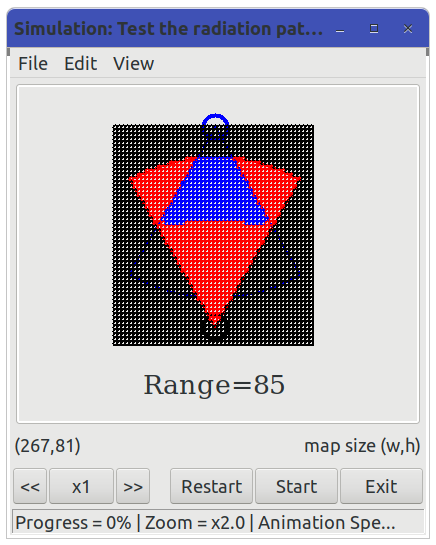
This example is used to test the radiation footprint of a transceiver design. In this example, we place a transmitting BS on the south, and interfering BS on north, and many vehicles on the map from the north to the south.
If a vehicle can decode a transmission from the transmitting BS, then it shows red (strong SNR). If it can receive the transmission but failed to decode due to interference, it shows blue (strong SNR but weak SINR). If it is outside of the coverage, it shows black (poor SNR).
To demonstrate how this test code can be used, we applied a built-in
transceiver design and built a mmWave 28GHz transceiver model based on
UserTransceiver, and we test their radiation
footprints.
To test your own transceiver design, simply change create_transceiver_bs2() and create_transceiver_vehicle2() to include your design and pick option 2 to run.
Show source code
'''
This example demonstrates the use of :class:`comm.transceiver.UserTransceiver`.
It uses :class:`comm.signalwave.QualityBasedSignal` for transmission. It
illustrates how users can implement own signal propagation and detection logic.

In this example, we have two moving vehicles and we let the base station
(BS) connect to both if they can detect the signal from the BS.
This example shows how signal propagation and detection logic can be
implemented at the user simulation level if users need some special treatment
and full control of signal propagation and signal detection logic.

We assume that the BS can track vehicles. The channel model is based on [WFY20]_.

References
----------
.. [WFY20] P. Wang, J. Fang, X. Yuan, Z. Chen, and H. Li, "Intelligent
    reflecting surface-assisted millimeter wave communications: Joint
    active and passive precoding design," IEEE Transactions on Vehicular
    Technology, vol. 69, no. 12, pp. 14960-14973, 2020.
'''

import wx
import math
import argparse
from argparse import Namespace, ArgumentParser
from typing import Dict, List, Tuple

from sim import World, BaseScenario, Drawable, Dir2D, ScreenXY as XY
from node import BaseNode, NodeType, Obstacle, Stationary, StaticPath
from comm import UserTransceiver

####################################################################
## My Transceiver
## - Perform own signal propagation and detection logic
## - Aware of an obstacle
####################################################################

class MyTransceiver(UserTransceiver):

    ## class constants or default values
    noise = -90 # dBm
    snr_threshold = 5 # dB

    def __init__(self, node, freq, tx_power, ant_element):
        super().__init__(node,freq)
        self.obstacle_list = None
        self.tx_power = tx_power
        self.ant_element = ant_element
        self.snr_threshold = MyTransceiver.snr_threshold

    def create_signal(self, tx_power=None):
        '''Use this method to create a signal.

        Parameters
        ----------
        tx_power : float
            The transmit power of the signal.

        Returns
        -------
        :class:`comm.signalwave.QualityBasedSignal`
            The created signal to be used for transmission.
        '''
        signal = super().create_signal()
        if tx_power is None: signal.tx_power = self.tx_power
        signal.add_info("ant element",self.ant_element) # number of antenna elements
        return signal

    def set_obstacle(self, obstacle_list):
        self.obstacle_list = obstacle_list

    def is_crossed_obstacle(self, tx_loc, rx_loc) -> bool:
        if self.obstacle_list is None: return False
        point1 = tx_loc.get_xy()
        point2 = rx_loc.get_xy()
        return self.obstacle_list.is_crossed(point1,point2)

    def can_detect(self, the_signal) -> bool:
        '''This is the function to perform signal propagation and
        detection logic.'''

        ## retrieve all key info first
        tx_power = the_signal.tx_power      # get the tx power in dBm
        distance = the_signal.distance      # get the distance travelled
        travelling_dir = the_signal.LOS_dir # get the travelling direction
        tx_loc = the_signal.source._node.get("location") # sender location
        rx_loc = self._node.get("location")              # receiver location

        ## check if signal is crossing obstacle
        is_crossed = self.is_crossed_obstacle(tx_loc,rx_loc)

        ## apply simple passloss model c0*d^(-α), where
        #  - d is the distance, in our system, 2 pixels = 1m, minimum 1m
        #  - α is the pathloss exponent, 2 for normal, 2.92 when crossing an obstacle
        #  - c0 is the gain/loss
        ## pathloss PL_db = log10(c0) + 10α*log10(d)
        distance /= 2             # convert pixel-to-meter
        if distance<1: distance=1 # min 1m
        alpha = 2 if not is_crossed else 2.92   # set pathloss exponent
        log_c0 = 61.4 if not is_crossed else 72 # set loss
        pathloss_db = log_c0 + 10*alpha*math.log10(distance)

        ## received power including the gain from the number of antenna elements
        ant_element_num = the_signal.get_info("ant element")
        received_power = tx_power - pathloss_db + 10*math.log10(ant_element_num)

        ## check if the signal is detectable, i.e. its SNR
        ## exceeds the threshold (default setting, see `MyTransceiver.snr_threshold`)
        snr = received_power-MyTransceiver.noise
        if snr>=MyTransceiver.snr_threshold:
            the_signal.quality = received_power
            the_signal.add_info("crossed_obstacle",is_crossed)
            return True # can detect
        else:
            the_signal.quality = None
            return False # cannot detect

class MyTransceiverBS(MyTransceiver):
    def __init__(self, node):
        super().__init__(node, freq=28, tx_power=30, ant_element=64)

class MyTransceiverVehicle(MyTransceiver):
    def __init__(self, node):
        super().__init__(node, freq=28, tx_power=20, ant_element=1)

####################################################################
## Nodes
####################################################################

class MyBS(BaseNode):
    '''
    MyBS: This is a base station in the VANET sim world implementing
    a user-defined transceiver.
    '''
    def __init__(self, simworld, id, loc):
        super().__init__(simworld, id, node_type=NodeType.BaseStation(self))

        self.transceiver = MyTransceiverBS(self)

        ## setup the BS
        self.set_transceiver(self.transceiver)
        self.set_mobility(Stationary(loc))

class MyVehicle(BaseNode):
    '''
    MyVehicle: This is a transmitting node in the VANET sim world implementing
    a user-defined transceiver.
    '''
    def __init__(self, simworld, id):
        super().__init__(simworld, id, node_type=NodeType.Vehicle(self))

        ## initialize some properties
        self.transceiver = MyTransceiverVehicle(self)
        self.set_transceiver(self.transceiver)

        self.associated_bs = None
        self.connection_quality = None
        self.crossed_obstacle = False

    ## draw a line to the connected BS, if any
    def show_connection(self):
        self.clear_drawing()
        if self.associated_bs is not None:
            self.associated_bs.clear_drawing()
            if self.crossed_obstacle:
                self.draw_line(self.associated_bs,pen = wx.Pen(wx.BLUE,1,style=wx.PENSTYLE_SHORT_DASH))
                self.set_color(wx.BLUE)
                self.draw_text(10,-15,"Non-LOS: %1.2fdB"%(self.connection_quality-MyTransceiver.noise),
                                wx.Font(10, wx.FONTFAMILY_ROMAN, wx.FONTSTYLE_NORMAL,
                                            wx.FONTWEIGHT_NORMAL))
            else:
                self.draw_line(self.associated_bs,pen = wx.Pen(wx.BLACK,2,style=wx.PENSTYLE_SOLID))
                self.set_color(wx.BLACK)
                self.draw_text(10,-15,"LOS: %1.2fdB"%(self.connection_quality-MyTransceiver.noise),
                                wx.Font(10, wx.FONTFAMILY_ROMAN, wx.FONTSTYLE_NORMAL,
                                            wx.FONTWEIGHT_NORMAL))
        else:
            self.set_color(wx.RED)
            self.draw_text(10,-15,"No Signal",
                            wx.Font(10, wx.FONTFAMILY_ROMAN, wx.FONTSTYLE_NORMAL,
                                        wx.FONTWEIGHT_NORMAL))


####################################################################
## Scenario
####################################################################

class MyScenario(BaseScenario):
    '''
    MyScenario: This is my scenario.
    '''
    ##---------------------------------------------------------------
    ## This method will be called before the start of the simulation,
    ## build the simulation world here
    def on_create(self, simworld) -> bool:

        ## give a name
        self.set_name("A vehicle passing by a BS with some obstacles")

        ## create two obstacles
        self.my_obstacle_list = Obstacle()
        self.my_obstacle_list.add_rect(x=260, y=70, w=70, h=20)
        self.my_obstacle_list.add_rect(x=200, y=80, w=30, h=10)
        for each_block in self.my_obstacle_list.get_list():
            self.add_drawable(Drawable().polygon(each_block)
                                        .set_drawing(wx.BLUE_PEN,wx.YELLOW_BRUSH))

        ## create a BS on the map
        self.bs = MyBS(simworld, "BS", XY(250,50))
        self.bs.transceiver.set_obstacle(self.my_obstacle_list)

        ## create several passing vehicles
        self.vehicles = []

        path = [ (60, XY(200,210)), (30, XY(450,210)) ]
        node = MyVehicle(simworld, "Vehicle1")
        node.set_mobility(StaticPath(start_loc=XY(50,210),path=path))
        node.transceiver.set_obstacle(self.my_obstacle_list)
        self.vehicles.append(node)

        path = [ (40, XY(200,245)), (50, XY(450,245)) ]
        node = MyVehicle(simworld, "Vehicle2")
        node.set_mobility(StaticPath(start_loc=XY(50,245),path=path))
        node.transceiver.set_obstacle(self.my_obstacle_list)
        self.vehicles.append(node)

        return True

    ##-------------------------------------------------------------
    ## This method will be called repeatedly until the simulation
    ## is ended or stopped, perform any user simulation action here
    def on_event(self, sim_time, event_obj):

        ## BS transmission to vehicles
        for vehicle in self.vehicles:

            ## send a packet to the tracked vehicle
            packet = self.bs.transceiver.create_signal()
            recv_signal = self.bs.transceiver.unicast(packet,vehicle)
            if recv_signal is None:
                vehicle.associated_bs = None
                vehicle.connection_quality = None
            else:
                vehicle.associated_bs = self.bs
                vehicle.connection_quality = recv_signal.quality
                vehicle.crossed_obstacle = recv_signal.get_info("crossed_obstacle")

        ## show connections
        for vehicle in self.vehicles:
            vehicle.show_connection()

####################################################################
## main
####################################################################

if __name__ == "__main__":

    ## command line parameters
    parser: ArgumentParser = argparse.ArgumentParser()
    parser.add_argument("--nodisplay", help="Run in no GUI mode", action="store_true")
    parser.add_argument("--step", help="Mobility step time (in sec)", type=int, default=0.2)
    parser.add_argument("--speed", help="Animation playback speed (x times)", type=float, default=1.0)
    parser.add_argument("--duration", help="Simulation duration (in sec), -1 for non-stop", type=int, default=1)
    args: Namespace = parser.parse_args()

    ## welcome info
    print("A Simple VANET Environment. Press [^C] to quit")
    #args.nodisplay = True  # <-- hardcoding no GUI mode
    args.step = 0.1         # <-- hardcoding the mobility step time
    args.speed = 1.0        # <-- hardcoding the animation speed (times)
    args.duration = 15.0     # <-- hardcoding the sim duration (sec)

    if args.nodisplay:   print("- simulation will run without animation")
    else:                print("- animation will playback at x%1.2f speed"%args.speed)
    print("- vehicles move a step every %1.2f s in simulation"%args.step)
    if args.duration>0:  print("- simulation will stop at %1.2f s"%args.duration)
    else:                print("- simulation will run non-stop")

    ## create, setup and run the simulation
    ## note that to run a simulation, we need to create a 'scenario'
    run_flag = True
    while run_flag:
        sim = World()
        sim.config(sim_stop = args.duration,
                sim_step = args.step,
                sim_speed = args.speed,
                display_option = not args.nodisplay,
                scenario = MyScenario(sim))

        print("\nRunning PyMoSim version v%d.%d.%d"%sim.version())
        run_flag = sim.run()
Example 5b
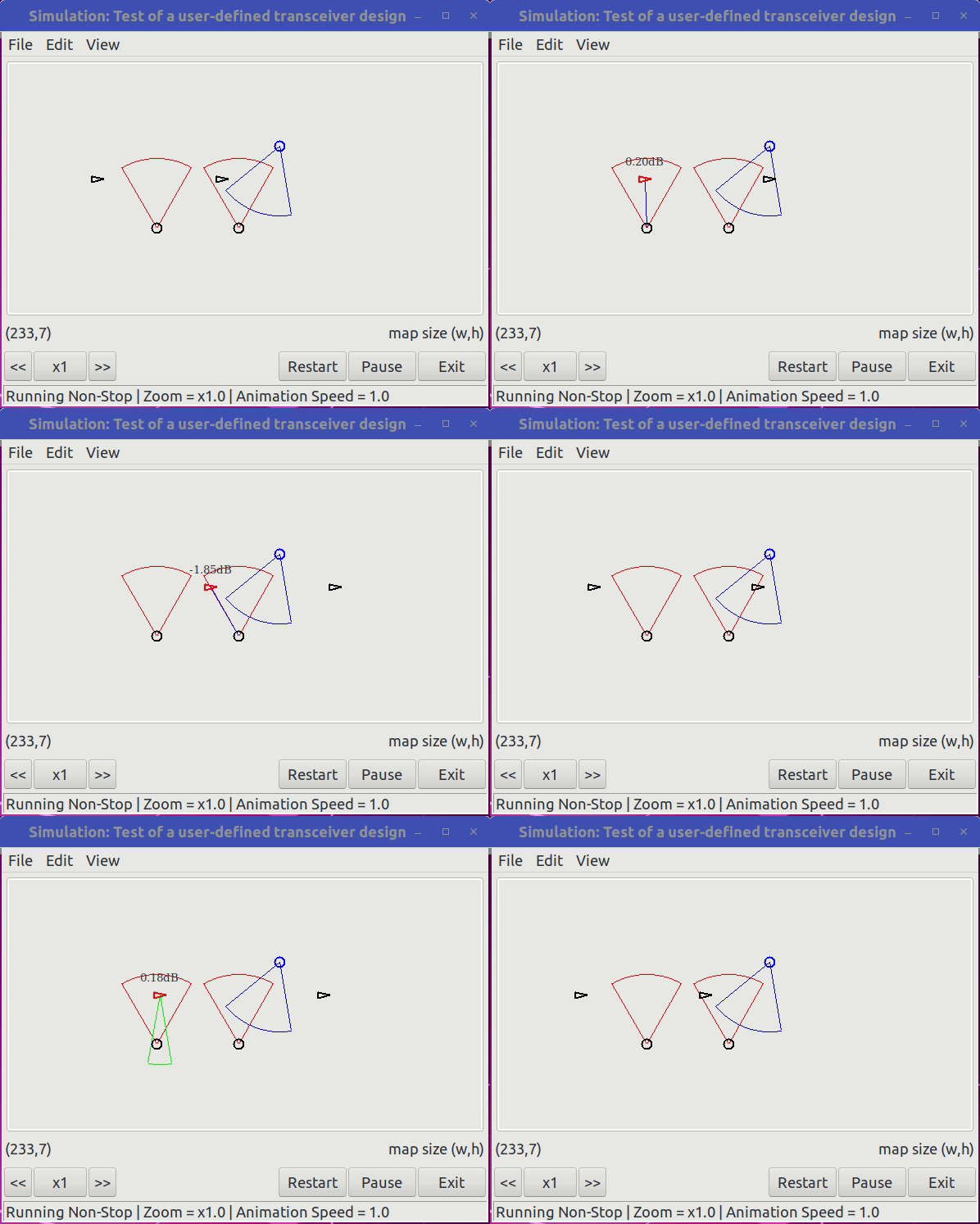
This example demonstrates how to design a new user-defined transceiver.
We extended UserTransceiver to build a
mmWave 28GHz transceiver model.
In this example, we place two transmitting BS on the south, and an interfering BS on north. We also put two vehicles in the scenario to measure the receiving SINR.
The first vehicle uses an omnidirectional antenna, we can see a drop in SINR when entering the interfering region (shown in blue).
The second vehicle uses a directional antenna with fixed angle pointing to the south. We can see that no interference is experienced when crossing the interfering BS.
Show source code
'''
This example demonstrates the use of :class:`comm.transceiver.UserTransceiver`.
It uses :class:`comm.signalwave.QualityBasedSignal` for transmission. It
illustrates how users can implement own signal propagation and detection logic.

In this example, we have two moving vehicles and we let the base station
(BS) connect to both if they can detect the signal from the BS.
This example shows how signal propagation and detection logic can be
implemented at the user simulation level if users need some special treatment
and full control of signal propagation and signal detection logic.

We assume that the BS can track vehicles. The channel model is based on [WFY20]_.

References
----------
.. [WFY20] P. Wang, J. Fang, X. Yuan, Z. Chen, and H. Li, "Intelligent
    reflecting surface-assisted millimeter wave communications: Joint
    active and passive precoding design," IEEE Transactions on Vehicular
    Technology, vol. 69, no. 12, pp. 14960-14973, 2020.
'''

import wx
import math
import argparse
from argparse import Namespace, ArgumentParser
from typing import Dict, List, Tuple

from sim import World, BaseScenario, Drawable, Dir2D, ScreenXY as XY
from node import BaseNode, NodeType, Obstacle, Stationary, StaticPath
from comm import UserTransceiver

####################################################################
## My Transceiver
## - Perform own signal propagation and detection logic
## - Aware of an obstacle
####################################################################

class MyTransceiver(UserTransceiver):

    ## class constants or default values
    noise = -90 # dBm
    snr_threshold = 5 # dB

    def __init__(self, node, freq, tx_power, ant_element):
        super().__init__(node,freq)
        self.obstacle_list = None
        self.tx_power = tx_power
        self.ant_element = ant_element
        self.snr_threshold = MyTransceiver.snr_threshold

    def create_signal(self, tx_power=None):
        '''Use this method to create a signal.

        Parameters
        ----------
        tx_power : float
            The transmit power of the signal.

        Returns
        -------
        :class:`comm.signalwave.QualityBasedSignal`
            The created signal to be used for transmission.
        '''
        signal = super().create_signal()
        if tx_power is None: signal.tx_power = self.tx_power
        signal.add_info("ant element",self.ant_element) # number of antenna elements
        return signal

    def set_obstacle(self, obstacle_list):
        self.obstacle_list = obstacle_list

    def is_crossed_obstacle(self, tx_loc, rx_loc) -> bool:
        if self.obstacle_list is None: return False
        point1 = tx_loc.get_xy()
        point2 = rx_loc.get_xy()
        return self.obstacle_list.is_crossed(point1,point2)

    def can_detect(self, the_signal) -> bool:
        '''This is the function to perform signal propagation and
        detection logic.'''

        ## retrieve all key info first
        tx_power = the_signal.tx_power      # get the tx power in dBm
        distance = the_signal.distance      # get the distance travelled
        travelling_dir = the_signal.LOS_dir # get the travelling direction
        tx_loc = the_signal.source._node.get("location") # sender location
        rx_loc = self._node.get("location")              # receiver location

        ## check if signal is crossing obstacle
        is_crossed = self.is_crossed_obstacle(tx_loc,rx_loc)

        ## apply simple passloss model c0*d^(-α), where
        #  - d is the distance, in our system, 2 pixels = 1m, minimum 1m
        #  - α is the pathloss exponent, 2 for normal, 2.92 when crossing an obstacle
        #  - c0 is the gain/loss
        ## pathloss PL_db = log10(c0) + 10α*log10(d)
        distance /= 2             # convert pixel-to-meter
        if distance<1: distance=1 # min 1m
        alpha = 2 if not is_crossed else 2.92   # set pathloss exponent
        log_c0 = 61.4 if not is_crossed else 72 # set loss
        pathloss_db = log_c0 + 10*alpha*math.log10(distance)

        ## received power including the gain from the number of antenna elements
        ant_element_num = the_signal.get_info("ant element")
        received_power = tx_power - pathloss_db + 10*math.log10(ant_element_num)

        ## check if the signal is detectable, i.e. its SNR
        ## exceeds the threshold (default setting, see `MyTransceiver.snr_threshold`)
        snr = received_power-MyTransceiver.noise
        if snr>=MyTransceiver.snr_threshold:
            the_signal.quality = received_power
            the_signal.add_info("crossed_obstacle",is_crossed)
            return True # can detect
        else:
            the_signal.quality = None
            return False # cannot detect

class MyTransceiverBS(MyTransceiver):
    def __init__(self, node):
        super().__init__(node, freq=28, tx_power=30, ant_element=64)

class MyTransceiverVehicle(MyTransceiver):
    def __init__(self, node):
        super().__init__(node, freq=28, tx_power=20, ant_element=1)

####################################################################
## Nodes
####################################################################

class MyBS(BaseNode):
    '''
    MyBS: This is a base station in the VANET sim world implementing
    a user-defined transceiver.
    '''
    def __init__(self, simworld, id, loc):
        super().__init__(simworld, id, node_type=NodeType.BaseStation(self))

        self.transceiver = MyTransceiverBS(self)

        ## setup the BS
        self.set_transceiver(self.transceiver)
        self.set_mobility(Stationary(loc))

class MyVehicle(BaseNode):
    '''
    MyVehicle: This is a transmitting node in the VANET sim world implementing
    a user-defined transceiver.
    '''
    def __init__(self, simworld, id):
        super().__init__(simworld, id, node_type=NodeType.Vehicle(self))

        ## initialize some properties
        self.transceiver = MyTransceiverVehicle(self)
        self.set_transceiver(self.transceiver)

        self.associated_bs = None
        self.connection_quality = None
        self.crossed_obstacle = False

    ## draw a line to the connected BS, if any
    def show_connection(self):
        self.clear_drawing()
        if self.associated_bs is not None:
            self.associated_bs.clear_drawing()
            if self.crossed_obstacle:
                self.draw_line(self.associated_bs,pen = wx.Pen(wx.BLUE,1,style=wx.PENSTYLE_SHORT_DASH))
                self.set_color(wx.BLUE)
                self.draw_text(10,-15,"Non-LOS: %1.2fdB"%(self.connection_quality-MyTransceiver.noise),
                                wx.Font(10, wx.FONTFAMILY_ROMAN, wx.FONTSTYLE_NORMAL,
                                            wx.FONTWEIGHT_NORMAL))
            else:
                self.draw_line(self.associated_bs,pen = wx.Pen(wx.BLACK,2,style=wx.PENSTYLE_SOLID))
                self.set_color(wx.BLACK)
                self.draw_text(10,-15,"LOS: %1.2fdB"%(self.connection_quality-MyTransceiver.noise),
                                wx.Font(10, wx.FONTFAMILY_ROMAN, wx.FONTSTYLE_NORMAL,
                                            wx.FONTWEIGHT_NORMAL))
        else:
            self.set_color(wx.RED)
            self.draw_text(10,-15,"No Signal",
                            wx.Font(10, wx.FONTFAMILY_ROMAN, wx.FONTSTYLE_NORMAL,
                                        wx.FONTWEIGHT_NORMAL))


####################################################################
## Scenario
####################################################################

class MyScenario(BaseScenario):
    '''
    MyScenario: This is my scenario.
    '''
    ##---------------------------------------------------------------
    ## This method will be called before the start of the simulation,
    ## build the simulation world here
    def on_create(self, simworld) -> bool:

        ## give a name
        self.set_name("A vehicle passing by a BS with some obstacles")

        ## create two obstacles
        self.my_obstacle_list = Obstacle()
        self.my_obstacle_list.add_rect(x=260, y=70, w=70, h=20)
        self.my_obstacle_list.add_rect(x=200, y=80, w=30, h=10)
        for each_block in self.my_obstacle_list.get_list():
            self.add_drawable(Drawable().polygon(each_block)
                                        .set_drawing(wx.BLUE_PEN,wx.YELLOW_BRUSH))

        ## create a BS on the map
        self.bs = MyBS(simworld, "BS", XY(250,50))
        self.bs.transceiver.set_obstacle(self.my_obstacle_list)

        ## create several passing vehicles
        self.vehicles = []

        path = [ (60, XY(200,210)), (30, XY(450,210)) ]
        node = MyVehicle(simworld, "Vehicle1")
        node.set_mobility(StaticPath(start_loc=XY(50,210),path=path))
        node.transceiver.set_obstacle(self.my_obstacle_list)
        self.vehicles.append(node)

        path = [ (40, XY(200,245)), (50, XY(450,245)) ]
        node = MyVehicle(simworld, "Vehicle2")
        node.set_mobility(StaticPath(start_loc=XY(50,245),path=path))
        node.transceiver.set_obstacle(self.my_obstacle_list)
        self.vehicles.append(node)

        return True

    ##-------------------------------------------------------------
    ## This method will be called repeatedly until the simulation
    ## is ended or stopped, perform any user simulation action here
    def on_event(self, sim_time, event_obj):

        ## BS transmission to vehicles
        for vehicle in self.vehicles:

            ## send a packet to the tracked vehicle
            packet = self.bs.transceiver.create_signal()
            recv_signal = self.bs.transceiver.unicast(packet,vehicle)
            if recv_signal is None:
                vehicle.associated_bs = None
                vehicle.connection_quality = None
            else:
                vehicle.associated_bs = self.bs
                vehicle.connection_quality = recv_signal.quality
                vehicle.crossed_obstacle = recv_signal.get_info("crossed_obstacle")

        ## show connections
        for vehicle in self.vehicles:
            vehicle.show_connection()

####################################################################
## main
####################################################################

if __name__ == "__main__":

    ## command line parameters
    parser: ArgumentParser = argparse.ArgumentParser()
    parser.add_argument("--nodisplay", help="Run in no GUI mode", action="store_true")
    parser.add_argument("--step", help="Mobility step time (in sec)", type=int, default=0.2)
    parser.add_argument("--speed", help="Animation playback speed (x times)", type=float, default=1.0)
    parser.add_argument("--duration", help="Simulation duration (in sec), -1 for non-stop", type=int, default=1)
    args: Namespace = parser.parse_args()

    ## welcome info
    print("A Simple VANET Environment. Press [^C] to quit")
    #args.nodisplay = True  # <-- hardcoding no GUI mode
    args.step = 0.1         # <-- hardcoding the mobility step time
    args.speed = 1.0        # <-- hardcoding the animation speed (times)
    args.duration = 15.0     # <-- hardcoding the sim duration (sec)

    if args.nodisplay:   print("- simulation will run without animation")
    else:                print("- animation will playback at x%1.2f speed"%args.speed)
    print("- vehicles move a step every %1.2f s in simulation"%args.step)
    if args.duration>0:  print("- simulation will stop at %1.2f s"%args.duration)
    else:                print("- simulation will run non-stop")

    ## create, setup and run the simulation
    ## note that to run a simulation, we need to create a 'scenario'
    run_flag = True
    while run_flag:
        sim = World()
        sim.config(sim_stop = args.duration,
                sim_step = args.step,
                sim_speed = args.speed,
                display_option = not args.nodisplay,
                scenario = MyScenario(sim))

        print("\nRunning PyMoSim version v%d.%d.%d"%sim.version())
        run_flag = sim.run()
Example 5c
This example demonstrates how to further extends a new user-defined transceiver. The earlier example created a mmWave 28GHz transceiver model which supports omnidirectional and predefined fixed directional antenna designs. Here we extend the transceiver design to include the feature of tracking of senders and receivers.
The first vehicle uses an onmidirectional antenna. The second vehicle uses a directional antenna with fixed pointing angle. The third vehicle uses the directional antenna with tracking feature.
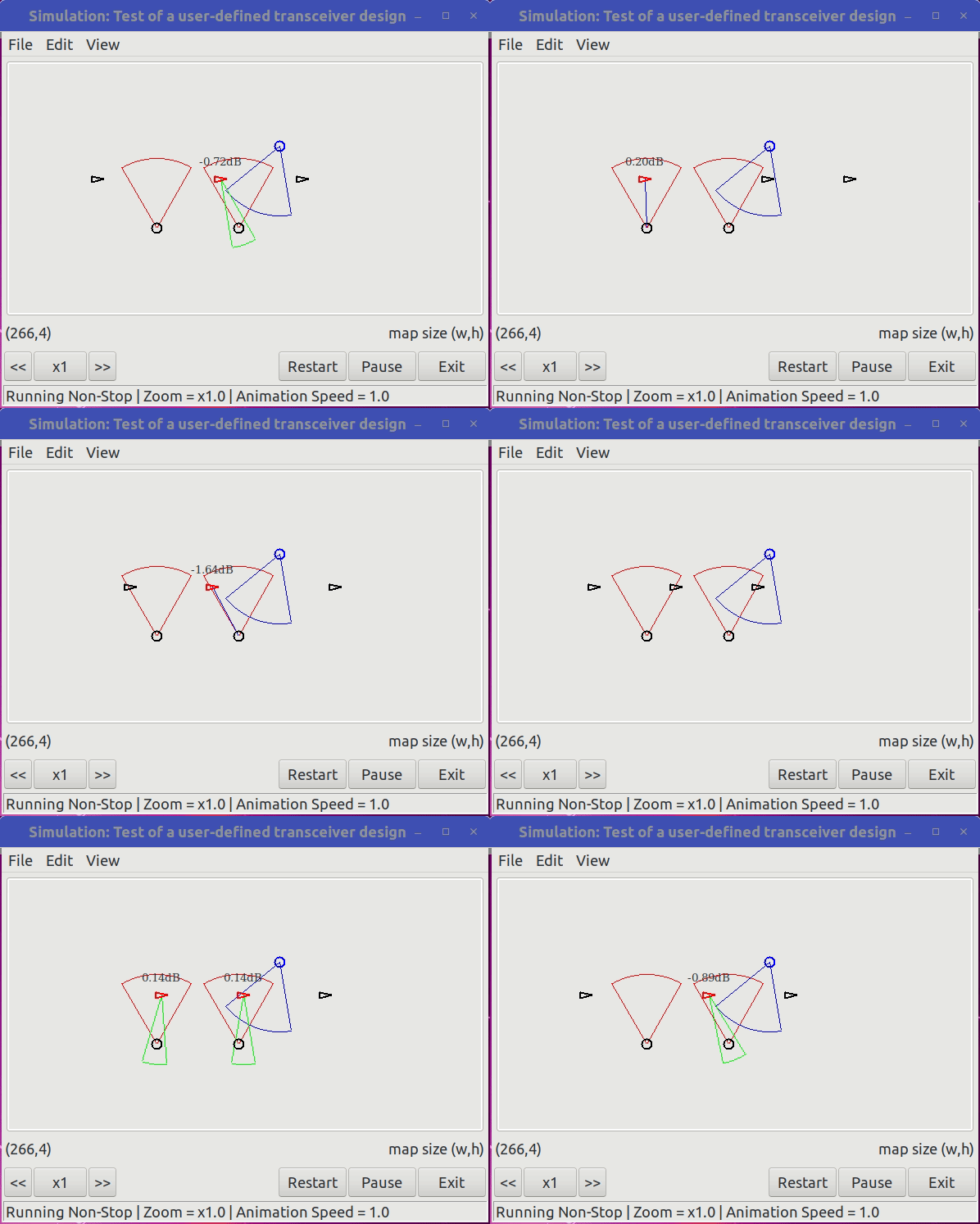
Show source code
'''
This example demonstrates the use of :class:`comm.transceiver.UserTransceiver`.
It uses :class:`comm.signalwave.QualityBasedSignal` for transmission. It
illustrates how users can implement own signal propagation and detection logic.

In this example, we have two moving vehicles and we let the base station
(BS) connect to both if they can detect the signal from the BS.
This example shows how signal propagation and detection logic can be
implemented at the user simulation level if users need some special treatment
and full control of signal propagation and signal detection logic.

We assume that the BS can track vehicles. The channel model is based on [WFY20]_.

References
----------
.. [WFY20] P. Wang, J. Fang, X. Yuan, Z. Chen, and H. Li, "Intelligent
    reflecting surface-assisted millimeter wave communications: Joint
    active and passive precoding design," IEEE Transactions on Vehicular
    Technology, vol. 69, no. 12, pp. 14960-14973, 2020.
'''

import wx
import math
import argparse
from argparse import Namespace, ArgumentParser
from typing import Dict, List, Tuple

from sim import World, BaseScenario, Drawable, Dir2D, ScreenXY as XY
from node import BaseNode, NodeType, Obstacle, Stationary, StaticPath
from comm import UserTransceiver

####################################################################
## My Transceiver
## - Perform own signal propagation and detection logic
## - Aware of an obstacle
####################################################################

class MyTransceiver(UserTransceiver):

    ## class constants or default values
    noise = -90 # dBm
    snr_threshold = 5 # dB

    def __init__(self, node, freq, tx_power, ant_element):
        super().__init__(node,freq)
        self.obstacle_list = None
        self.tx_power = tx_power
        self.ant_element = ant_element
        self.snr_threshold = MyTransceiver.snr_threshold

    def create_signal(self, tx_power=None):
        '''Use this method to create a signal.

        Parameters
        ----------
        tx_power : float
            The transmit power of the signal.

        Returns
        -------
        :class:`comm.signalwave.QualityBasedSignal`
            The created signal to be used for transmission.
        '''
        signal = super().create_signal()
        if tx_power is None: signal.tx_power = self.tx_power
        signal.add_info("ant element",self.ant_element) # number of antenna elements
        return signal

    def set_obstacle(self, obstacle_list):
        self.obstacle_list = obstacle_list

    def is_crossed_obstacle(self, tx_loc, rx_loc) -> bool:
        if self.obstacle_list is None: return False
        point1 = tx_loc.get_xy()
        point2 = rx_loc.get_xy()
        return self.obstacle_list.is_crossed(point1,point2)

    def can_detect(self, the_signal) -> bool:
        '''This is the function to perform signal propagation and
        detection logic.'''

        ## retrieve all key info first
        tx_power = the_signal.tx_power      # get the tx power in dBm
        distance = the_signal.distance      # get the distance travelled
        travelling_dir = the_signal.LOS_dir # get the travelling direction
        tx_loc = the_signal.source._node.get("location") # sender location
        rx_loc = self._node.get("location")              # receiver location

        ## check if signal is crossing obstacle
        is_crossed = self.is_crossed_obstacle(tx_loc,rx_loc)

        ## apply simple passloss model c0*d^(-α), where
        #  - d is the distance, in our system, 2 pixels = 1m, minimum 1m
        #  - α is the pathloss exponent, 2 for normal, 2.92 when crossing an obstacle
        #  - c0 is the gain/loss
        ## pathloss PL_db = log10(c0) + 10α*log10(d)
        distance /= 2             # convert pixel-to-meter
        if distance<1: distance=1 # min 1m
        alpha = 2 if not is_crossed else 2.92   # set pathloss exponent
        log_c0 = 61.4 if not is_crossed else 72 # set loss
        pathloss_db = log_c0 + 10*alpha*math.log10(distance)

        ## received power including the gain from the number of antenna elements
        ant_element_num = the_signal.get_info("ant element")
        received_power = tx_power - pathloss_db + 10*math.log10(ant_element_num)

        ## check if the signal is detectable, i.e. its SNR
        ## exceeds the threshold (default setting, see `MyTransceiver.snr_threshold`)
        snr = received_power-MyTransceiver.noise
        if snr>=MyTransceiver.snr_threshold:
            the_signal.quality = received_power
            the_signal.add_info("crossed_obstacle",is_crossed)
            return True # can detect
        else:
            the_signal.quality = None
            return False # cannot detect

class MyTransceiverBS(MyTransceiver):
    def __init__(self, node):
        super().__init__(node, freq=28, tx_power=30, ant_element=64)

class MyTransceiverVehicle(MyTransceiver):
    def __init__(self, node):
        super().__init__(node, freq=28, tx_power=20, ant_element=1)

####################################################################
## Nodes
####################################################################

class MyBS(BaseNode):
    '''
    MyBS: This is a base station in the VANET sim world implementing
    a user-defined transceiver.
    '''
    def __init__(self, simworld, id, loc):
        super().__init__(simworld, id, node_type=NodeType.BaseStation(self))

        self.transceiver = MyTransceiverBS(self)

        ## setup the BS
        self.set_transceiver(self.transceiver)
        self.set_mobility(Stationary(loc))

class MyVehicle(BaseNode):
    '''
    MyVehicle: This is a transmitting node in the VANET sim world implementing
    a user-defined transceiver.
    '''
    def __init__(self, simworld, id):
        super().__init__(simworld, id, node_type=NodeType.Vehicle(self))

        ## initialize some properties
        self.transceiver = MyTransceiverVehicle(self)
        self.set_transceiver(self.transceiver)

        self.associated_bs = None
        self.connection_quality = None
        self.crossed_obstacle = False

    ## draw a line to the connected BS, if any
    def show_connection(self):
        self.clear_drawing()
        if self.associated_bs is not None:
            self.associated_bs.clear_drawing()
            if self.crossed_obstacle:
                self.draw_line(self.associated_bs,pen = wx.Pen(wx.BLUE,1,style=wx.PENSTYLE_SHORT_DASH))
                self.set_color(wx.BLUE)
                self.draw_text(10,-15,"Non-LOS: %1.2fdB"%(self.connection_quality-MyTransceiver.noise),
                                wx.Font(10, wx.FONTFAMILY_ROMAN, wx.FONTSTYLE_NORMAL,
                                            wx.FONTWEIGHT_NORMAL))
            else:
                self.draw_line(self.associated_bs,pen = wx.Pen(wx.BLACK,2,style=wx.PENSTYLE_SOLID))
                self.set_color(wx.BLACK)
                self.draw_text(10,-15,"LOS: %1.2fdB"%(self.connection_quality-MyTransceiver.noise),
                                wx.Font(10, wx.FONTFAMILY_ROMAN, wx.FONTSTYLE_NORMAL,
                                            wx.FONTWEIGHT_NORMAL))
        else:
            self.set_color(wx.RED)
            self.draw_text(10,-15,"No Signal",
                            wx.Font(10, wx.FONTFAMILY_ROMAN, wx.FONTSTYLE_NORMAL,
                                        wx.FONTWEIGHT_NORMAL))


####################################################################
## Scenario
####################################################################

class MyScenario(BaseScenario):
    '''
    MyScenario: This is my scenario.
    '''
    ##---------------------------------------------------------------
    ## This method will be called before the start of the simulation,
    ## build the simulation world here
    def on_create(self, simworld) -> bool:

        ## give a name
        self.set_name("A vehicle passing by a BS with some obstacles")

        ## create two obstacles
        self.my_obstacle_list = Obstacle()
        self.my_obstacle_list.add_rect(x=260, y=70, w=70, h=20)
        self.my_obstacle_list.add_rect(x=200, y=80, w=30, h=10)
        for each_block in self.my_obstacle_list.get_list():
            self.add_drawable(Drawable().polygon(each_block)
                                        .set_drawing(wx.BLUE_PEN,wx.YELLOW_BRUSH))

        ## create a BS on the map
        self.bs = MyBS(simworld, "BS", XY(250,50))
        self.bs.transceiver.set_obstacle(self.my_obstacle_list)

        ## create several passing vehicles
        self.vehicles = []

        path = [ (60, XY(200,210)), (30, XY(450,210)) ]
        node = MyVehicle(simworld, "Vehicle1")
        node.set_mobility(StaticPath(start_loc=XY(50,210),path=path))
        node.transceiver.set_obstacle(self.my_obstacle_list)
        self.vehicles.append(node)

        path = [ (40, XY(200,245)), (50, XY(450,245)) ]
        node = MyVehicle(simworld, "Vehicle2")
        node.set_mobility(StaticPath(start_loc=XY(50,245),path=path))
        node.transceiver.set_obstacle(self.my_obstacle_list)
        self.vehicles.append(node)

        return True

    ##-------------------------------------------------------------
    ## This method will be called repeatedly until the simulation
    ## is ended or stopped, perform any user simulation action here
    def on_event(self, sim_time, event_obj):

        ## BS transmission to vehicles
        for vehicle in self.vehicles:

            ## send a packet to the tracked vehicle
            packet = self.bs.transceiver.create_signal()
            recv_signal = self.bs.transceiver.unicast(packet,vehicle)
            if recv_signal is None:
                vehicle.associated_bs = None
                vehicle.connection_quality = None
            else:
                vehicle.associated_bs = self.bs
                vehicle.connection_quality = recv_signal.quality
                vehicle.crossed_obstacle = recv_signal.get_info("crossed_obstacle")

        ## show connections
        for vehicle in self.vehicles:
            vehicle.show_connection()

####################################################################
## main
####################################################################

if __name__ == "__main__":

    ## command line parameters
    parser: ArgumentParser = argparse.ArgumentParser()
    parser.add_argument("--nodisplay", help="Run in no GUI mode", action="store_true")
    parser.add_argument("--step", help="Mobility step time (in sec)", type=int, default=0.2)
    parser.add_argument("--speed", help="Animation playback speed (x times)", type=float, default=1.0)
    parser.add_argument("--duration", help="Simulation duration (in sec), -1 for non-stop", type=int, default=1)
    args: Namespace = parser.parse_args()

    ## welcome info
    print("A Simple VANET Environment. Press [^C] to quit")
    #args.nodisplay = True  # <-- hardcoding no GUI mode
    args.step = 0.1         # <-- hardcoding the mobility step time
    args.speed = 1.0        # <-- hardcoding the animation speed (times)
    args.duration = 15.0     # <-- hardcoding the sim duration (sec)

    if args.nodisplay:   print("- simulation will run without animation")
    else:                print("- animation will playback at x%1.2f speed"%args.speed)
    print("- vehicles move a step every %1.2f s in simulation"%args.step)
    if args.duration>0:  print("- simulation will stop at %1.2f s"%args.duration)
    else:                print("- simulation will run non-stop")

    ## create, setup and run the simulation
    ## note that to run a simulation, we need to create a 'scenario'
    run_flag = True
    while run_flag:
        sim = World()
        sim.config(sim_stop = args.duration,
                sim_step = args.step,
                sim_speed = args.speed,
                display_option = not args.nodisplay,
                scenario = MyScenario(sim))

        print("\nRunning PyMoSim version v%d.%d.%d"%sim.version())
        run_flag = sim.run()
Example 6
This is an example demonstrating how to load a map and perform some mobility. The program uses the built-in path-finding algorithm (i.e. A*STAR) to establish routes for vehicles. This example introduces the following features:
How to use a map for the simulation, including accessing the pins defined in the map.
How to create vehicles that move on the map given specific start and end locations. This example uses
node.mobility.StaticPathwhich is a static path mobility. For this mobility, vehicles move independently where they simply ignore other vehicles on the same road, and hence vehicles can and will overlap with others when moving on the map.
In this example, we use base station (BS) centric where a BS will send a beacon message to collect reply packy quality from all vehicles, and then associate with the vehicle with the highest quality (i.e. strongest SNR).
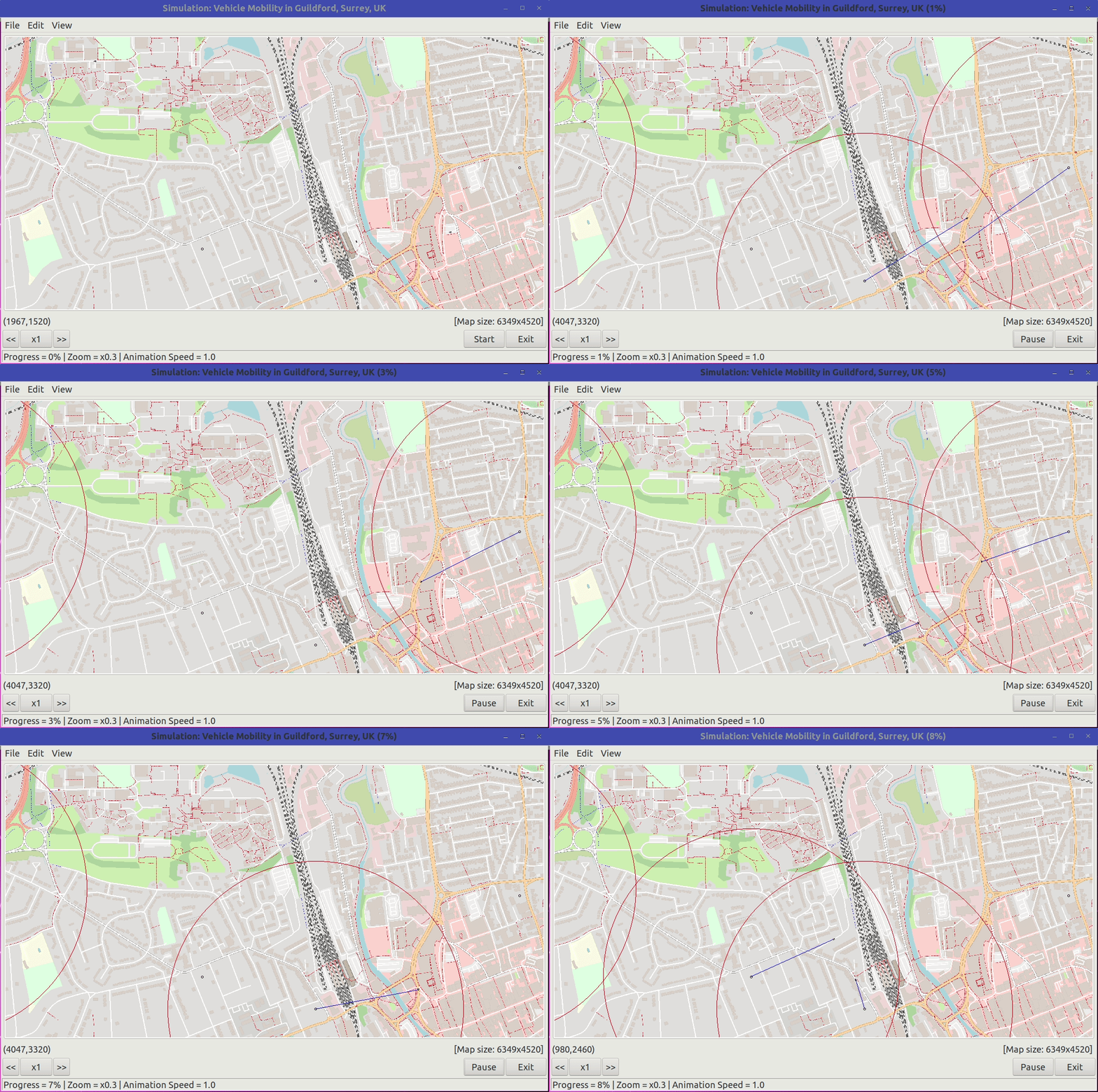
Show source code
'''
This is an example demonstrating how to load a map and perform some mobility. The program
uses the built-in path-finding algorithm (i.e. A*STAR) to establish routes for vehicles.
This example introduces the following features:

- How to use a map for the simulation, including accessing the pins defined in the map.
- How to create vehicles that move on the map given specific start and end locations.
  This example uses :class:`node.mobility.StaticPath` which is a static path mobility.
  For this mobility, vehicles move independently where they simply ignore other
  vehicles on the same road, and hence vehicles can and will overlap with others when
  moving on the map.

In this example, we use base station (BS) centric where a BS will send a beacon message
to collect reply packy quality from all vehicles, and then associate with the vehicle
with the highest quality (i.e. strongest SNR).
'''

import wx
import operator
import random

from sim  import World, BaseScenario, Event, ScreenXY as XY
from node import BaseNode, NodeType
from node import Stationary, StaticPath
from comm import Transceiver, DiscModel
from map  import MapInfo


####################################################################
## Base station & Vehicle
####################################################################

class MyBS(BaseNode):
    '''MyBS: This is a base station design.'''
    def __init__(self, simworld, id, loc, freq, channel):
        super().__init__(simworld, id, node_type=NodeType.BaseStation(self))
        self.transceiver = Transceiver(self,freq,channel)
        self.coverage = self.transceiver.get_property("radius")

        self.serving_node = None

        ## setup BS
        self.set_transceiver(self.transceiver)
        self.set_mobility(Stationary(loc))

    def lost_vehicle(self, sim_time):
        self.serving_node.lost_bs(sim_time)
        self.serving_node = None

    def connect_vehicle(self, vehicle, sim_time):
        self.serving_node = vehicle
        self.serving_node.connect_bs(self, sim_time)

    def show_coverage(self):
        self.clear_drawing()
        if self.serving_node!=None:
            self.draw_circle(self.coverage)

class MyVehicle(BaseNode):
    '''MyVehicle: This is a vehicle design.'''
    def __init__(self, simworld, id, map, freq, channel):
        super().__init__(simworld, id, node_type=NodeType.Vehicle(self))
        self.transceiver = Transceiver(self,freq,channel)
        self.set_transceiver(self.transceiver)
        self.map = map

        self.associated_bs = None

    def set_route(self, start_pin, end_pin, speed_low, speed_high) -> bool:
        path = self.map.find_path(start_pin,end_pin)
        if len(path)==0: return False # can't find a path

        route = []
        x,y,_ = path[0] # unpack the starting point
        start_loc = XY(x,y) # create an XY point
        speed = random.uniform(speed_low,speed_high)   # in km/h
        speed = self.map.kph(speed, speed_up_factor=5) # in pixels/sec
        for waypoint in path[1:]:
            route.append((speed,XY(waypoint[0],waypoint[1])))

        self.set_mobility(StaticPath(start_loc,route))
        self.end_pin = end_pin
        return True

    def lost_bs(self, sim_time):
        self.associated_bs = None

    def connect_bs(self, bs, sim_time):
        self.associated_bs = bs

    def show_connection(self):
        self.clear_drawing()
        if self.associated_bs!=None:
            self.draw_line(self.associated_bs)
            self.set_color(wx.BLACK)
        else:
            self.set_color(wx.RED)

####################################################################
## Scenario setup
####################################################################

class MyScenario(BaseScenario):
    '''This is MyScenario. It reimplements on_create() and on_event().'''

    def on_create(self, simworld) -> bool: # this will be called at the start

        ## load the map image and info
        map = MapInfo()
        map.load_file(image_file="Guildford-UK.png",
                      data_file="Guildford-UK.json")
        if not map.is_ready():
            print("Failed to load the map. The reason is: %s\n"%map.get_err_str())
            return False

        ## use the map and give a name to this scenario
        self.use_map(map)
        self.set_name("Vehicle Mobility in Guildford, Surrey, UK")

        ## load some pin location info from the map to place the BSs
        bs_loc = { "BS-1": None, "BS-2": None, "BS-3": None, "BS-4": None }
        for pin_name in bs_loc:
            bs_loc[pin_name] = map.get_pin_xy(pin_name)
            if bs_loc[pin_name]==None:
                print("Failed to load this pin: %s."%pin_name)
                return False

        ## create BSs at those loaded locations
        self.all_bs_nodes = []
        carrier_freq = 2.4
        ch_omni = DiscModel(radius=map.km(0.5))
        for pin_name in bs_loc:
            new_bs = MyBS(simworld, pin_name, XY(xy=bs_loc[pin_name]), carrier_freq, ch_omni)
            self.all_bs_nodes.append(new_bs)

        ## create some vehicles
        self.all_vehicles = []
        self.parking = [ "NorthStreetParking", "GuildfordStationParking",
                         "SpectrumParking",    "Lido",
                         "G-LiveParking",      "6GIC",
                         "TescoParking",       "FortRoad" ]
        for i in range(10):
            this_vehicle = MyVehicle(simworld, "Car %d"%i, map, carrier_freq, ch_omni)
            while True:
                start = random.choice(self.parking)
                end = random.choice(self.parking)
                if end==start: continue
                if this_vehicle.set_route(start, end, speed_low=30, speed_high=50):
                    break # route successful established, break
            self.all_vehicles.append(this_vehicle)

        return True

    # this will be called repeatedly
    def on_event(self, sim_time, event_obj):

        ## distribute the following events
        if event_obj==Event.MOBILITY_END: # a mobile node has finished its mobility?
            self.do_restart_node(sim_time,event_obj)
        elif event_obj==Event.SIM_MOBILITY: # mobility progresses a time step?
            self.do_mobility(sim_time,event_obj)

    ## end of mobility, then find another parking location to move to
    def do_restart_node(self, sim_time, event_obj):
        this_node = event_obj.get("node") # get the node reaching end of mobility
        start = this_node.end_pin    # this will be the start location
        while True:
            end = random.choice(self.parking)  # end location is a random choice
            if end==start: continue
            if this_node.set_route(start, end, speed_low=30, speed_high=50):
                break # route successful established, break

    ## Do user simulation here
    def do_mobility(self, sim_time, event_obj):

        ## iterate all BSs to check its vehicle connectivity
        for bs in self.all_bs_nodes:

            vehicle = bs.serving_node
            if vehicle==None: continue # skip if none

            beacon = bs.transceiver.create_signal()
            if bs.transceiver.unicast(beacon,vehicle) is None: # lost connection
                bs.lost_vehicle(sim_time)

        ## main task: make associatiation with a vehicle if available
        for bs in self.all_bs_nodes:

            ## step 1: check service status, skip if already serving a vehicle
            if bs.serving_node!=None: continue

            ## step 2: find strongest SNR to associate
            vehicle_max = None
            detection_list = []
            beacon = bs.transceiver.create_signal()
            vehicle_list = bs.transceiver.broadcast(beacon)
            for (vehicle,signal) in vehicle_list:
                ## 2.1 check that the reachable node is a vehicle without service
                if vehicle.type!=NodeType.Vehicle: continue # skip if not Vehicle
                if vehicle.associated_bs!=None: continue # skip if already being served

                ## 2.2 vehicle sends beacon reply for bs to measure signal quality
                beacon_reply = vehicle.transceiver.create_signal()
                recv_signal = vehicle.transceiver.unicast(beacon_reply,bs)
                if recv_signal is None: continue # skip if failed, likely not in coverage

                ## 2.3 append to the detection list
                detection_list.append((vehicle,recv_signal.quality))

            ## step 3: associate with the vehicle with the strongest SNR, if exists
            if len(detection_list)!=0:
                vehicle_max = max(detection_list,key=operator.itemgetter(1))[0]
            if vehicle_max!=None:
                bs.connect_vehicle(vehicle_max,sim_time)

        ## draw connectivity & bs coverage on the map
        for vehicle in self.all_vehicles:
            vehicle.show_connection()
        for bs in self.all_bs_nodes:
            bs.show_coverage()

####################################################################
## The Main
####################################################################

if __name__ == "__main__":

    ## create, setup and run the simulation
    ## note that to run a simulation, we need to create a 'scenario'
    run_flag = True
    while run_flag:
        sim = World()
        sim.config(sim_stop=500,
                sim_step=0.1,
                sim_speed=1.0,
                display_option=True,
                scenario=MyScenario(sim))

        print("\nRunning PyMoSim version v%d.%d.%d"%sim.version())
        run_flag = sim.run()
Example 7
This is an example demonstrating a traffic light control. The example introduces three features:
How to create a timer. The timer is used to control the traffic lights.
How to displace a text on the map.
How to use
node.mobility2.RoutePathto create mobility. In this mobility model, vehicles are aware of others and must follow the vehicles in front. The mobility implementation uses a specific car following model to achieve realistic mobility.
We place two traffic lights at two junctions and create some volume of traffic around the junctions.
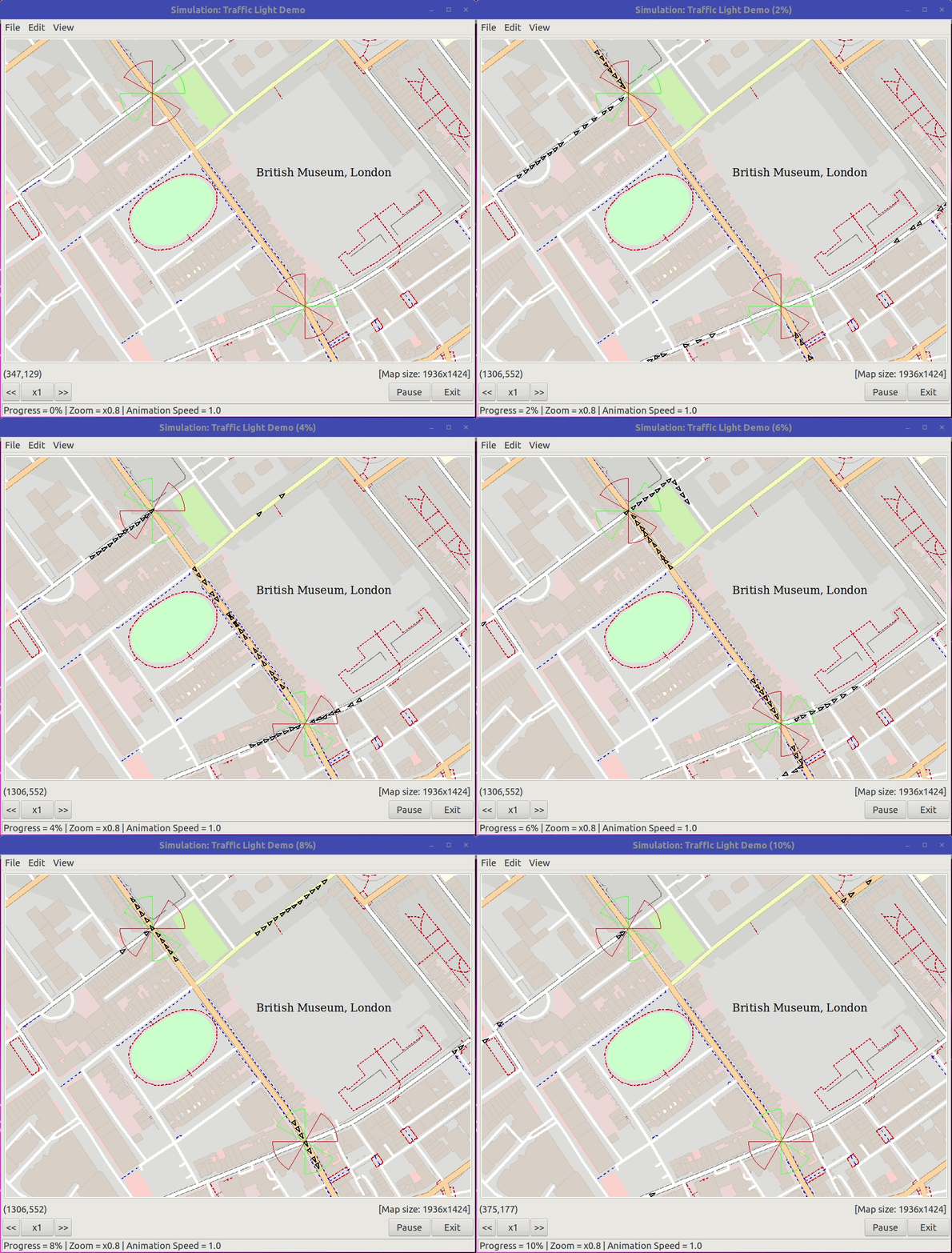
Show source code
'''
This is an example demonstrating a traffic light control. The example introduces
three features:

- How to create a timer. The timer is used to control the traffic lights.
- How to displace a text on the map.
- How to use :class:`node.mobility2.RoutePath` to create mobility. In this mobility model,
  vehicles are aware of others and must follow the vehicles in front. The mobility
  implementation uses a specific car following model to achieve realistic mobility.

We place two traffic lights at two junctions and create some volume of traffic
around the junctions.
'''

import wx
import random

from sim import World, Event, BaseScenario, Drawable, Draw
from sim import Dir2D, ScreenXY as XY
from node import BaseNode, NodeTimer, NodeType, Stationary
from node.mobility2 import RouteHandler, RoutePath
from map import MapInfo, MapPin


####################################################################
## Traffic Light & Vehicle
####################################################################

class MyTrafficLight(BaseNode):
    '''MyTrafficLight: This is a traffic light design.'''
    def __init__(self, simworld, id, loc, angle):
        super().__init__(simworld, id, node_type=NodeType.Hidden(self))
        self.set_mobility(Stationary(loc))

        self.two_sides = { Dir2D(angle):1, Dir2D(angle+180):1,
                           Dir2D(angle+90):2, Dir2D(angle+270):2 }
        self.indicator1 = { 1: "green", 2: "red" } # one side green, another side red
        self.indicator2 = { 1: "red", 2: "green" }
        self.active_indicator  = self.indicator1

        self.timer = NodeTimer(self, random.uniform(10,15))
        self.timer.start()
        self.redraw_indicator()

    def get_indicator(self, vehicle) -> str:
        car_direction = vehicle.get("direction") # the traffic light needs to find out
        for dir,side in self.two_sides.items():  #        which side the car is facing
            if car_direction.is_within(dir,45):
                return self.active_indicator[side] # found the side, return indicator

        print("Something is wrong") # shouldn't reach this line
        return "red"

    def switch_indicator(self):
        if self.active_indicator is self.indicator1:
            self.active_indicator = self.indicator2
        else:
            self.active_indicator = self.indicator1
        self.timer.start()
        self.redraw_indicator()

    def redraw_indicator(self):
        self.clear_drawing()
        for this_dir,this_side in self.two_sides.items(): # draw a sector for each side
            if self.active_indicator[this_side]=="green":
                pen = wx.GREEN_PEN
            else:
                pen = wx.RED_PEN
            self.draw_sector(80,this_dir.get_azimuth(),60,pen)

class MyVehicle(BaseNode):
    '''MyVehicle: This is a vehicle design.'''
    def __init__(self, simworld, id, map):
        super().__init__(simworld, id, node_type=NodeType.Vehicle(self))
        self.map = map
        self.visible_range = map.num_pixels(len_in_meter=10)

    def set_route(self, handler, start_pin, end_pin, speed_low, speed_high, delay_start) -> bool:
        route = RoutePath(handler,start_pin,end_pin,delay_start)
        road_segment_list = route.get_road_segment_list()
        if (len(road_segment_list)==0): return False

        ## set a random speed to each road segment in the route
        for i in range(len(road_segment_list)):
            speed = random.uniform(speed_low,speed_high)   # in km/h
            speed = self.map.kph(speed, speed_up_factor=5) # in pixels/sec
            route.assign_speed(i,speed)

        ## assign the mobility to this node
        self.set_mobility(route)
        return True

    def can_see_traffic_light(self, loc):
        if self.get("location").distance_to(loc)>self.visible_range:
            return False # outside of range, can't see

        angle_to_the_loc = Dir2D(self.get("location").azimuth_to(loc))
        current_moving_angle = self.get("direction")
        if not current_moving_angle.is_within(angle_to_the_loc,45): # +/- 45 degree
            return False # not moving towards the location, can't see

        return True # yes, within driver's vision

    def stop(self):
        self.get("mobility").pause()

    def go(self):
        self.get("mobility").pause(False)


####################################################################
## Scenario setup
####################################################################

class MyScenario(BaseScenario):
    '''This is MyScenario. It reimplements on_create() and on_event().'''

    def on_create(self, simworld) -> bool: # this will be called at the start

        ## load the map image and info
        self.map = MapInfo()
        self.map.load_file(image_file="British-Museum.png",
                           data_file="British-Museum.json")
        if not self.map.is_ready():
            print("Failed to load the map. The reason is: %s\n"%self.map.get_err_str())
            return False

        ## use the map and give a name to this scenario
        self.use_map(self.map)
        self.set_name("Traffic Light Demo")

        ## load the landmark pin, show it on the map with a fancy font
        ## we shall use `pin` module to access to the pin properties
        my_landmark = MapPin.Landmark(self.map,pin_name="BritishMuseum")
        if my_landmark.is_valid():
            (x,y) = my_landmark.get_xy()
            pin_text = my_landmark.get_display_name(default="British Museum")
            self.add_drawable(Drawable()
                    .text(x,y,pin_text,position=Draw.XYCENTER)
                    .set_font(wx.Font(16, wx.FONTFAMILY_ROMAN, wx.FONTSTYLE_NORMAL,
                                          wx.FONTWEIGHT_NORMAL)))
        else:
            print("Warning: can't load landmark pin: 'BritishMuseum'.")

        ## load all other pins, since we only need their (x,y) location, we can access
        ## directly by using the `MapInfo` instance
        loc = { "North": None, "NorthWest": None, "West": None,
                "South": None, "NorthEast": None, "East": None,
                "TrafficLightNorth": None, "TrafficLightSouth": None }
        for pin_name in loc:
            loc[pin_name] = self.map.get_pin_xy(pin_name)
            if loc[pin_name]==None:
                print("Failed to load this pin: `%s`."%pin_name)
                return False

        ## create traffic lights
        self.traffic_lights = []
        for key in loc:
            if "TrafficLight" not in key: continue
            (x,y) = loc[key]
            this_light = MyTrafficLight(simworld, key, XY(x,y), angle=60)
            self.traffic_lights.append(this_light)

        ## create the route handler to manage mobility
        ## this is needed for `RoutePath` mobility
        route_handler = RouteHandler(self,self.map)
        if not route_handler.is_ready():
            print("Failed to create a route handler.")
            return False

        ## create some vehicles
        self.all_vehicles = []
        self.path_design = {}
        self.path_design["n-s"] = { "from": "North", "to": "South" }
        self.path_design["s-n"] = { "from": "South", "to": "North" }
        self.path_design["e-w"] = { "from": "East", "to": "West" }
        self.path_design["w-e"] = { "from": "West", "to": "East" }
        self.path_design["nw-ne"] = { "from": "NorthWest", "to": "NorthEast" }
        for path_name, path in self.path_design.items():
            start_pin = path["from"]
            end_pin = path["to"]
            for idx in range(random.randint(5,15)):
                this_vehicle = MyVehicle(simworld, "Car (%s)-%d"%(path_name,idx), self.map)
                if not this_vehicle.set_route(route_handler, start_pin, end_pin,
                                              speed_low=30, speed_high=50,
                                              delay_start=random.uniform(0,5)):
                    print("Failed to find a path from `%s` to `%s`."%(start_pin,end_pin))
                    print("Hint: check for path existence, also pay attention to one-way streets.")
                    return False
                self.all_vehicles.append(this_vehicle)

        return True

    ## this will be called repeatedly
    def on_event(self, sim_time, event_obj):

        ## distribute the following events
        if event_obj==Event.MOBILITY_END: # a mobile node has finished its mobility?
            self.do_restart_node(sim_time,event_obj)
        elif event_obj==Event.SIM_MOBILITY: # mobility progresses a time step?
            self.do_mobility(sim_time)
        elif event_obj==Event.TIMER_EXPIRED: # a timer expired?
            self.do_timer(sim_time,event_obj)

    ## end of mobility, then repeat the mobility again with a random delay start
    def do_restart_node(self, sim_time, event_obj):
        this_node = event_obj.get("node") # get the node reaching end of mobility
        this_node.get("mobility").restart(delay_start=random.uniform(0,5))

    ## a timer set by the traffic light has expired, switch light indicator
    def do_timer(self, sim_time, event_obj):
        this_traffic_light = event_obj.get("node") # get the node that started the timer
        this_traffic_light.switch_indicator()
        self.do_mobility(sim_time) # signal has changed, all vehicles should react

    ## Do user simulation here
    def do_mobility(self, sim_time):

        for vehicle in self.all_vehicles:

            for light in self.traffic_lights:
                if vehicle.can_see_traffic_light(light.get("location")):
                    if light.get_indicator(vehicle)=="red":
                        vehicle.stop()
                    else:
                        vehicle.go() # continue driving for any non "red" return

####################################################################
## The Main
####################################################################

if __name__ == "__main__":

    run_flag = True
    while run_flag:
        sim = World()
        sim.config(sim_stop=500,
                sim_step=0.1,
                sim_speed=1.0,
                display_option=True,
                scenario=MyScenario(sim))

        print("\nRunning PyMoSim version v%d.%d.%d"%sim.version())
        run_flag = sim.run()
Example 8
This example demonstrates how to implement reconfigurable intelligent
surface (RIS) using comm.transceiver.UserTransceiver. It also
uses comm.signalwave.QualityBasedSignal for transmission. It
illustrates how users can implement multipath signal propagation and
detection logic. The example is an extension of example5.py which shows
how to use comm.transceiver.UserTransceiver. It is important
to understand example5.py first.
The scenario replicates the experiment of single RIS case presented in [WFY20]. See also Fig. 2 in the paper for the experiment setup and Fig. 3 for the experiment results.
References
- WFY20
P. Wang, J. Fang, X. Yuan, Z. Chen, and H. Li, “Intelligent reflecting surface-assisted millimeter wave communications: Joint active and passive precoding design,” IEEE Transactions on Vehicular Technology, vol. 69, no. 12, pp. 14960-14973, 2020. (link: https://arxiv.org/pdf/1908.10734.pdf)
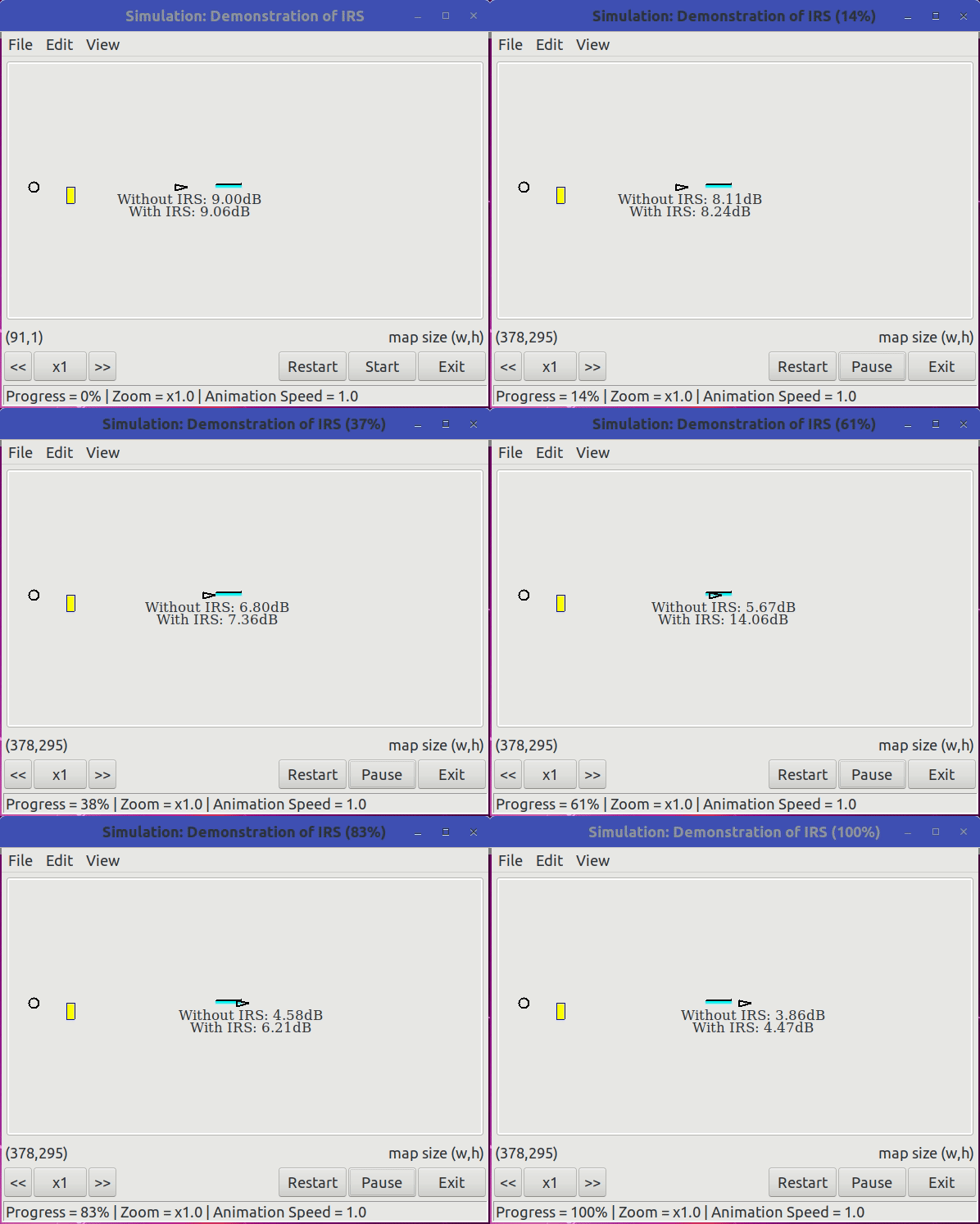
Result Comparison
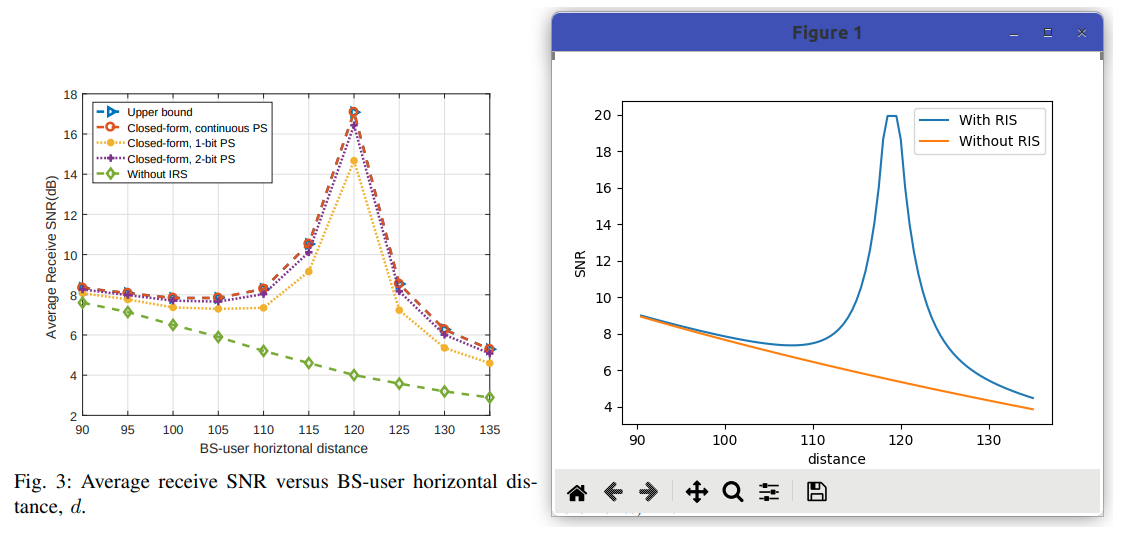
From the paper (left) versus from our simulation (right).
Show source code
'''
This example demonstrates how to implement reconfigurable intelligent
surface (RIS) using :class:`comm.transceiver.UserTransceiver`. It also
uses :class:`comm.signalwave.QualityBasedSignal` for transmission. It
illustrates how users can implement multipath signal propagation and
detection logic. The example is an extension of example5.py which shows
how to use :class:`comm.transceiver.UserTransceiver`. It is important
to understand example5.py first.

The scenario replicates the experiment of single RIS case presented in [WFY20]_.
See also Fig. 2 in the paper for the experiment setup and Fig. 3 for the
experiment results.

References
----------
.. [WFY20] P. Wang, J. Fang, X. Yuan, Z. Chen, and H. Li, "Intelligent
    reflecting surface-assisted millimeter wave communications: Joint
    active and passive precoding design," IEEE Transactions on Vehicular
    Technology, vol. 69, no. 12, pp. 14960-14973, 2020.
    (link: https://arxiv.org/pdf/1908.10734.pdf)
'''

import wx
import math
import argparse
from argparse import Namespace, ArgumentParser
from typing import Dict, List, Tuple

## import the following packages for plotting
import matplotlib.pyplot as plt

## PyMoSim packages
from sim import World, Event, BaseScenario, Drawable
from sim import Dir2D, ScreenXY as XY
from node import BaseNode, Obstacle, NodeType, Stationary, StaticPath
from comm.transceiver import UserTransceiver

####################################################################
## define coordination translation to match the example in [r1]
####################################################################

def resolution(): # pixel-to-meter ratio
    return 2

def x(x_val):
    return resolution()*x_val + 30

def y(y_val):
    return 150 - resolution()*y_val

####################################################################
## collect statistics
####################################################################

class Result:
    def __init__(self):
        self.x = []     # x is the distance
        self.ris = []   # with RIS
        self.nris = []  # without RIS

result = Result() # the instance

####################################################################
## My Transceiver
## - Perform own signal propagation and detection logic
## - Aware of an obstacle
####################################################################

class MyTransceiver(UserTransceiver):

    ## class constants
    noise = -90 # dBm
    snr_threshold = 2 # dB

    def __init__(self, node, azimuth_angle=None, beam_width=None, freq=28):
        '''Initialize and customize a transceiver.

        Parameters
        ----------
        azimuth_angle : float, optional, default=None
            If it is not None, it specifies the transceiver facing angle.
        beam_width : float, optional, default=None
            If `azimuth_angle` is not None, it specifies supported angle width.
            The supported angle is within the range
            [azimuth_angle-0.5*beam_width,azimuth_angle+0.5*beam_width].
        freq : float, optional, default=28
            The carrier frequency. Default is 28 (or 28 GHz mmWave).
        '''
        super().__init__(node,freq)
        self.azimuth = Dir2D(azimuth_angle) if azimuth_angle is not None else None
        self.beam_width = beam_width
        self.obstacle_list = None

    def create_signal(self, tx_power):
        '''Use this method to create a signal.

        Parameters
        ----------
        tx_power : float
            The transmit power of the signal.

        Returns
        -------
        :class:`comm.signalwave.QualityBasedSignal`
            The created signal to be used for transmission.
        '''
        signal = super().create_signal()
        signal.tx_power = tx_power
        signal.add_info("ant element",1) # number of antenna elements
        return signal

    def create_multipath_signal(self, tx_power):
        '''Use this method to create a signal that is part of a multipath
        signal. A multipath signal is a signal that consists of many paths
        of transmissions. It is meaningless to decode this signal alone, rather
        all parts of the multipath signal should be consolidated first before
        judging whether the multipath signal is detectable. To decode all parts,
        use `create_final_multipath_signal()` with passing all other parts of the
        signal when calling.

        Parameters
        ----------
        tx_power : float
            The transmit power of the signal.

        Returns
        -------
        :class:`comm.signalwave.QualityBasedSignal`
            The created signal to be used for transmission.
        '''
        signal = MyTransceiver.create_signal(self,tx_power)
        signal.add_info("multipath",True) # one part of a multipath signal
        return signal

    def create_final_multipath_signal(self, tx_power, signal_list):
        '''Use this method to create a final multipath signal. The receiver
        will finally consolidate all parts of the multipath signal and judge
        whether the consolidated signal is detectable.

        Parameters
        ----------
        signal_list : List of :class:`comm.signalwave.QualityBasedSignal`
            The list of all other received parts of the multipath signal to be
            consolidated for detection.
        '''
        signal = MyTransceiver.create_signal(self,tx_power)
        signal.add_info("multipath signals",signal_list)
        return signal

    def set_obstacle(self, obstacle_list):
        self.obstacle_list = obstacle_list

    def is_crossed_obstacle(self, tx_loc, rx_loc) -> bool:
        if self.obstacle_list is None: return False
        point1 = tx_loc.get_xy()
        point2 = rx_loc.get_xy()
        return self.obstacle_list.is_crossed(point1,point2)

    def can_detect(self, the_signal) -> bool:
        '''This is the function to perform signal propagation and
        detection logic.'''

        ## retrieve all key info first
        tx_power = the_signal.tx_power      # get the tx power in dBm
        distance = the_signal.distance      # get the distance travelled
        travelling_dir = the_signal.LOS_dir # get the travelling direction
        tx_loc = the_signal.source._node.get("location") # sender location
        rx_loc = self._node.get("location")              # receiver location
        tx_trx = the_signal.source._node.get("transceiver") # sender transceiver
        rx_trx = self._node.get("transceiver")              # receiver transceiver

        ## check if both sender and receiver support the angle
        if tx_trx.azimuth is not None:
            tx_dir = Dir2D(travelling_dir)
            if not tx_trx.azimuth.is_within(tx_dir,tx_trx.beam_width/2):
                return False # outside of sender's transmission angle coverage
        if rx_trx.azimuth is not None:
            rx_dir = Dir2D(travelling_dir+180)
            if not rx_trx.azimuth.is_within(rx_dir,rx_trx.beam_width/2):
                return False # outside of receiver's detection angle coverage

        ## check if signal is crossing obstacle
        is_crossed = self.is_crossed_obstacle(tx_loc,rx_loc)

        ## apply simple pathloss model c0*d^(-α), where
        #  - d is the distance, in our system, 2 pixels = 1m, minimum 1m
        #  - α is the pathloss exponent, 2 for normal, 2.92 when crossing an obstacle
        #  - c0 is the gain/loss
        ## pathloss PL_db = log10(c0) + 10α*log10(d)
        distance /= resolution()  # convert pixel-to-meter
        if distance<1: distance=1 # min 1m
        alpha = 2 if not is_crossed else 2.92   # set pathloss exponent
        log_c0 = 61.4 if not is_crossed else 72 # set loss
        pathloss_db = log_c0 + 10*alpha*math.log10(distance)

        ## received power including the gain from the number of antenna elements
        ant_element_num = the_signal.get_info("ant element")
        received_power = tx_power - pathloss_db + 10*math.log10(ant_element_num)

        ## check if the signal is one part of a multipath signal
        ## if so, return True for detectability
        if the_signal.get_info("multipath") is True:
            the_signal.quality = received_power
            the_signal.add_info("crossed_obstacle",is_crossed)
            return True # can detect as one of the multipath signals

        ## check if the signal is the final part of a multipath signal
        ## if so, consolidate all received powers
        multipath_signal_list = the_signal.get_info("multipath signals")
        if multipath_signal_list is not None:
            received_power_mW = 10**(received_power/10) # from this signal
            for each_signal in multipath_signal_list:
                received_power_mW += 10**(each_signal.quality/10) # each other part
            received_power = 10*math.log10(received_power_mW)

        ## check if the signal is detectable, i.e. its SNR
        ## exceeds the threshold (default setting, see `MyTransceiver.snr_threshold`)
        snr = received_power-MyTransceiver.noise
        if snr>=MyTransceiver.snr_threshold:
            the_signal.quality = received_power
            the_signal.add_info("crossed_obstacle",is_crossed)
            return True # can detect
        else:
            the_signal.quality = None
            return False # cannot detect

class MyTransceiverBS(MyTransceiver):

    def __init__(self, node):
        super().__init__(node)
        self.tx_power = 30 # dBm
        self.ant_element = 64

    def create_signal(self):
        the_signal = super().create_signal(self.tx_power)
        the_signal.add_info("ant element",self.ant_element) # number of antenna elements
        return the_signal

    def create_multipath_signal(self):
        the_signal = super().create_multipath_signal(self.tx_power)
        the_signal.add_info("ant element",self.ant_element) # number of antenna elements
        return the_signal

    def create_final_multipath_signal(self, signal_list):
        the_signal = super().create_final_multipath_signal(self.tx_power, signal_list)
        the_signal.add_info("ant element",self.ant_element) # number of antenna elements
        return the_signal

class MyTransceiverRIS(MyTransceiver):

    def __init__(self, node, azimuth_angle, beam_width):
        super().__init__(node, azimuth_angle, beam_width)
        self.ant_element = 200

    def is_crossed_obstacle(self, tx_loc, rx_loc) -> bool:
        '''Use this method to ignore obstacle between BS and RIS.'''
        return False

    def create_signal(self):
        return None # Do not use. RIS can't create own signal, it can only relay signal

    def create_multipath_signal(self, tx_power):
        the_signal = super().create_multipath_signal(tx_power)
        the_signal.add_info("ant element",self.ant_element**2) # RIS uses squared elements
        return the_signal

    def create_final_multipath_signal(self, signal_list):
        return None # Do not use. RIS should not create final signal

class MyTransceiverVehicle(MyTransceiver):
    pass # there is nothing needed to customize

####################################################################
## Nodes
####################################################################

class MyBS(BaseNode):
    '''
    MyBS: This is a base station in the VANET sim world implementing
    a user-defined transceiver.
    '''
    def __init__(self, simworld, id, loc):
        super().__init__(simworld, id, node_type=NodeType.BaseStation(self))

        self.transceiver = MyTransceiverBS(self)

        ## setup the BS
        self.set_transceiver(self.transceiver)
        self.set_mobility(Stationary(loc))

class MyVehicle(BaseNode):
    '''
    MyVehicle: This is a transmitting node in the VANET sim world implementing
    a user-defined transceiver.
    '''
    def __init__(self, simworld, id):
        super().__init__(simworld, id, node_type=NodeType.Vehicle(self))

        ## initialize some properties
        self.transceiver = MyTransceiverVehicle(self)
        self.set_transceiver(self.transceiver)

        self.associated_bs = None
        self.associated_ris = None
        self.connection_quality = None
        self.crossed_obstacle = False

    ## draw a line to the connected BS, if any
    def show_connection(self):
        self.clear_drawing()
        y_text_pos = 15 if self.id=="Vehicle1" else 30
        y_text = "Without RIS" if self.id=="Vehicle1" else "With RIS"
        if self.associated_bs is not None:
            self.set_color(wx.BLACK)
            self.draw_text(10,y_text_pos,
                    "%s: %1.2fdB"%(y_text,self.connection_quality-MyTransceiver.noise),
                    wx.Font(10, wx.FONTFAMILY_ROMAN, wx.FONTSTYLE_NORMAL, wx.FONTWEIGHT_NORMAL))
        else:
            self.set_color(wx.RED)
            self.draw_text(10,y_text_pos,"%s: No Signal"%y_text,
                            wx.Font(10, wx.FONTFAMILY_ROMAN, wx.FONTSTYLE_NORMAL,
                                        wx.FONTWEIGHT_NORMAL))

class MyRIS(BaseNode):
    '''
    MyRIS: This is an reconfigurable intelligent surface (RIS).
    '''
    def __init__(self, simworld, id, loc, azimuth_angle):
        super().__init__(simworld, id, node_type=NodeType.RIS(self,width=15))

        self.transceiver = MyTransceiverRIS(self,azimuth_angle,beam_width=180)

        ## setup the sector
        self.set_transceiver(self.transceiver)
        self.set_mobility(Stationary(location=loc,direction=Dir2D(azimuth_angle)))

####################################################################
## Scenario
####################################################################

class MyScenario(BaseScenario):
    '''
    MyScenario: This is my scenario.
    '''
    ##---------------------------------------------------------------
    ## This method will be called before the start of the simulation,
    ## build the simulation world here
    def on_create(self, simworld) -> bool:

        ## give a name
        self.set_name("Demonstration of RIS")

        ## create an obstacle to block the BS and the UE
        self.my_obstacle_list = Obstacle()
        self.my_obstacle_list.add_rect(x=x(20), y=y(0), w=10, h=20)
        for each_block in self.my_obstacle_list.get_list():
            self.add_drawable(Drawable().polygon(each_block)
                                        .set_drawing(wx.BLUE_PEN,wx.YELLOW_BRUSH))

        ## create a BS on the map
        self.bs = MyBS(simworld, "BS", XY(x(0),y(0)))
        self.bs.transceiver.set_obstacle(self.my_obstacle_list)

        ## create an RIS on the map
        self.ris = []
        ris = MyRIS(simworld, "RIS", XY(x(119),y(0.6)), azimuth_angle=180)
        ris.transceiver.set_obstacle(self.my_obstacle_list)
        self.ris.append(ris)

        ## create a UE twin, one assisted by RIS, one without
        self.vehicles = []

        path = [ (12, XY(x(135),y(0))) ]
        node = MyVehicle(simworld, "Vehicle1")
        node.set_mobility(StaticPath(start_loc=XY(x(90),y(0)),path=path))
        node.transceiver.set_obstacle(self.my_obstacle_list)
        self.vehicles.append(node)

        path = [ (12, XY(x(135),y(0))) ]
        node = MyVehicle(simworld, "Vehicle2")
        node.set_mobility(StaticPath(start_loc=XY(x(90),y(0)),path=path))
        node.transceiver.set_obstacle(self.my_obstacle_list)
        self.vehicles.append(node)

        return True

    ##-------------------------------------------------------------
    ## This method will be called repeatedly until the simulation
    ## is ended or stopped, perform any user simulation action here
    def on_event(self, sim_time, event_obj):

        ## process mobility event only & skip all other events
        if event_obj!=Event.SIM_MOBILITY: return

        ## initialize variables
        snr_ris = None
        snr_no_ris = None

        ## RIS service, here we hardcode the `RIS` to serve `Vehicle2`
        ris_service = {}
        ris_service[MyRIS.lookup("RIS")] = MyVehicle.lookup("Vehicle2") # comment out this line to disable RIS

        ## BS transmission to vehicles
        for vehicle in self.vehicles:

            ## vehicle with RIS will receive a multipath signal, one from RIS, another from BS
            ## here we need to prepare all reflected signals first
            reflected_signal = { vehicle:[] } # all reflected signals to this `vehicle`
            reflecting_ris = { vehicle:[] }   # all RISs reflecting the signals to this `vehicle`
            for this_ris in self.ris:
                if this_ris in ris_service and ris_service[this_ris] is vehicle:
                    reflecting_ris[vehicle].append(this_ris)
                    ## first hop, BS->RIS
                    packet = self.bs.transceiver.create_multipath_signal()
                    bs2ris_signal = self.bs.transceiver.unicast(packet,this_ris)
                    ## second hop, RIS->UE
                    ## and keep `reflecting_ris` and `reflected_signal` in the list
                    if bs2ris_signal is not None:
                        relay_packet = this_ris.transceiver.create_multipath_signal(bs2ris_signal.quality)
                        ris2node_signal = this_ris.transceiver.unicast(relay_packet,vehicle)
                        if ris2node_signal is not None:
                            reflected_signal[vehicle].append(ris2node_signal)

            ## check whether BS to Vehicle is single or multipath
            if len(reflecting_ris[vehicle])==0: # not served by RIS
                packet = self.bs.transceiver.create_signal()
                vehicle.associated_ris = None
            elif len(reflected_signal[vehicle])!=0: # served by RIS
                packet = self.bs.transceiver.create_final_multipath_signal(reflected_signal[vehicle])
                vehicle.associated_ris = reflecting_ris[vehicle]
            else: # served by RIS, but no signal, probably out of range
                packet = None
                vehicle.associated_ris = reflecting_ris[vehicle]

            ## retrieve the received signal after unicasting
            recv_signal = self.bs.transceiver.unicast(packet,vehicle) if packet is not None else None
            if packet is None or recv_signal is None:
                vehicle.associated_bs = None
                vehicle.associated_ris = None
                vehicle.connection_quality = None
            else:
                vehicle.associated_bs = self.bs
                vehicle.connection_quality = recv_signal.quality
                vehicle.crossed_obstacle = recv_signal.get_info("crossed_obstacle")
                if len(reflecting_ris[vehicle])==0:
                    snr_no_ris = recv_signal.quality - MyTransceiver.noise
                else:
                    snr_ris = recv_signal.quality - MyTransceiver.noise

        ## show signal strength
        distance = self.bs.get("location").distance_to(self.vehicles[0].get("location"))
        distance /= resolution()
        print(f"Distance = {distance:.1f}", end="")
        print(f", Without RIS = {snr_no_ris:.2f} dB" if snr_no_ris is not None else "", end="")
        print(f", With RIS = {snr_ris:.2f} dB" if snr_ris is not None else "")

        ## collect results
        result.x.append(distance)
        result.ris.append(snr_ris)
        result.nris.append(snr_no_ris)

        ## show connections
        for vehicle in self.vehicles:
            vehicle.show_connection()

####################################################################
## main
####################################################################

if __name__ == "__main__":

    ## command line parameters
    parser: ArgumentParser = argparse.ArgumentParser()
    parser.add_argument("--nodisplay", help="Run in no GUI mode", action="store_true")
    parser.add_argument("--step", help="Mobility step time (in sec)", type=int, default=0.2)
    parser.add_argument("--speed", help="Animation playback speed (x times)", type=float, default=1.0)
    parser.add_argument("--duration", help="Simulation duration (in sec), -1 for non-stop", type=int, default=1)
    args: Namespace = parser.parse_args()

    ## welcome info
    print("Demonstration of RIS. Press [^C] to quit")
    #args.nodisplay = True  # <-- hardcoding no GUI mode
    args.step = 0.1         # <-- hardcoding the mobility step time
    args.speed = 1.0        # <-- hardcoding the animation speed (times)
    args.duration = 9.0     # <-- hardcoding the sim duration (sec)

    if args.nodisplay:   print("- simulation will run without animation")
    else:                print("- animation will playback at x%1.2f speed"%args.speed)
    print("- vehicles move a step every %1.2f s in simulation"%args.step)
    if args.duration>0:  print("- simulation will stop at %1.2f s"%args.duration)
    else:                print("- simulation will run non-stop")

    ## create, setup and run the simulation
    ## note that to run a simulation, we need to create a 'scenario'
    run_flag = True
    while run_flag:
        sim = World()
        sim.config(sim_stop = args.duration,
                sim_step = args.step,
                sim_speed = args.speed,
                display_option = not args.nodisplay,
                scenario = MyScenario(sim))

        print("\nRunning PyMoSim version v%d.%d.%d"%sim.version())

        result = Result()
        run_flag = sim.run()

    ## plot results
    plt.plot(result.x, result.ris, label = "With RIS")
    plt.plot(result.x, result.nris, label = "Without RIS")
    plt.xlabel("distance")
    plt.ylabel("SNR")
    plt.legend()
    plt.show()